How to Use Femora's Sunshine Feature: Turn Time in the Sun Into Vitamin D
Femora's Sunshine feature estimates the vitamin D you make while you are actually in the sun: it reads the live UV index, asks what you are wearing and whether you have sunscreen on, then counts IU in real time with a lock screen Live Activity, a time-to-sunburn estimate, a shade countdown, progress toward the 600 IU NIH daily guideline, and optional Apple Health sync.

Most of us have no idea whether we are getting enough vitamin D. A blood test tells you where you stood weeks ago, food labels are a guessing game of IU and mcg, and "get some sun" advice never says how much sun, for your skin, at this hour, in what you are wearing.
Femora's Sunshine feature closes that gap. It estimates the vitamin D you are making during real sun exposure - live, while you are outside - using the current UV index at your location, your skin type, what you are wearing, and whether you have sunscreen on. Here is how to use it.
What the Sunshine screen shows you
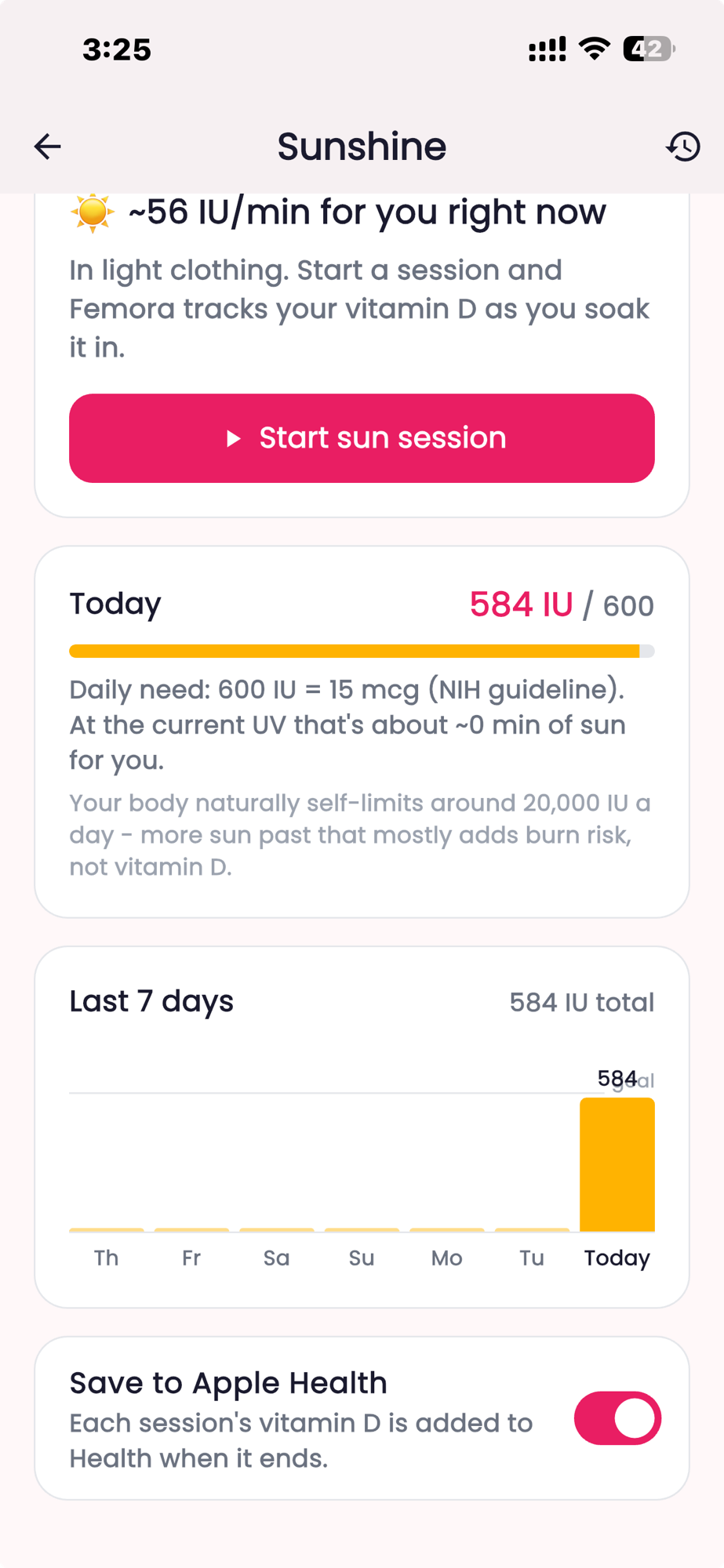
Open Sunshine from the app and you get three things at a glance:
- The live UV index for your location, with a plain-language rating and an estimate of how long unprotected skin takes to burn right now
- Your personal vitamin D rate - for example "~57 IU/min for you right now" - based on that UV level, your skin type, and your outfit
- Today's progress toward the daily goal of 600 IU (that is 15 mcg, the NIH guideline for most adults), plus a chart of your last 7 days
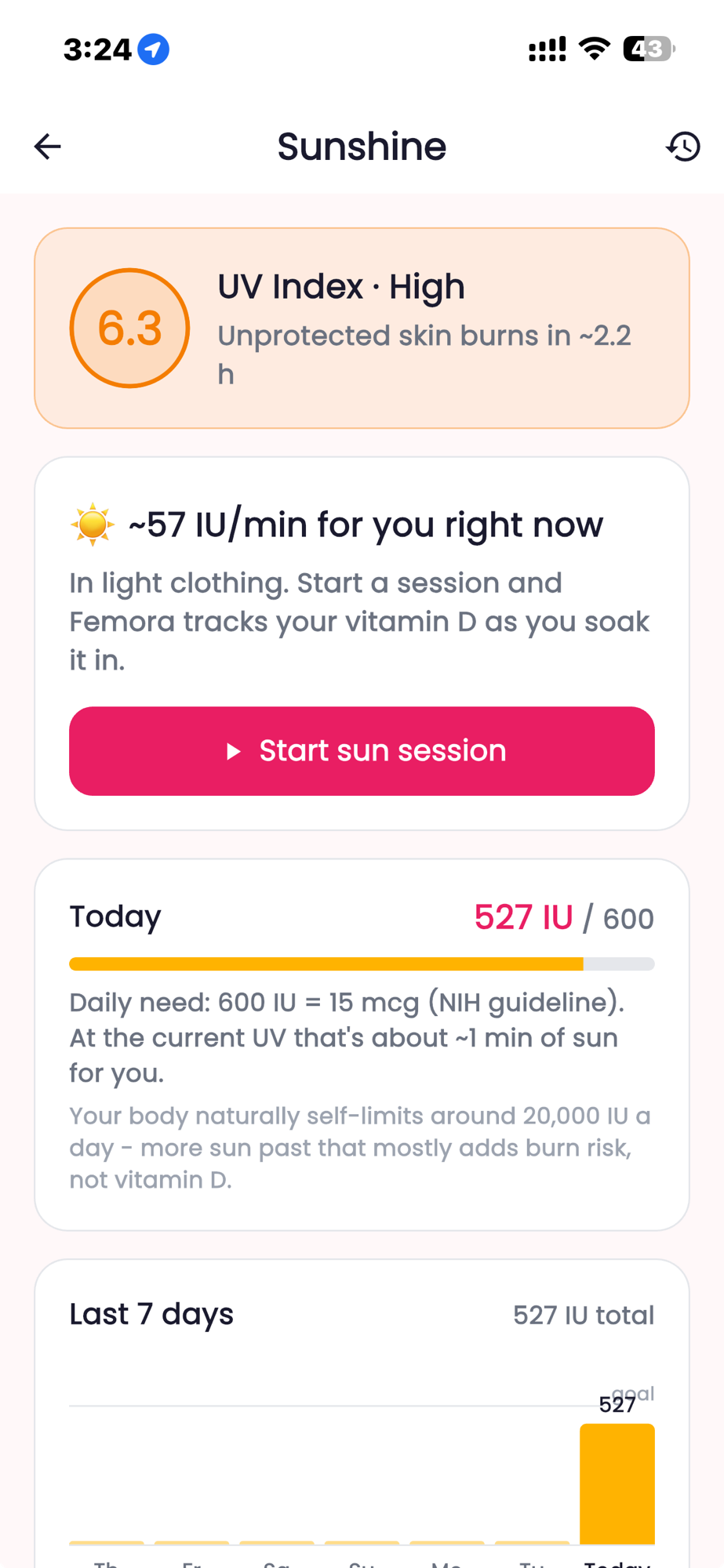
The screen also translates the goal into real terms: at a high UV index, your remaining vitamin D for the day might be "about ~1 min of sun for you." On a winter morning it could be an hour. That context is the whole point - the same 600 IU takes wildly different amounts of sun depending on conditions.
Step 1: Start a sun session
When you head outside, tap Start sun session. Femora asks two quick questions that change the math a lot:
- What you're wearing - from swimwear to full sleeves. More covered skin means less area making vitamin D, so the same minutes in the sun produce less.
- Sunscreen - none, or SPF 15 through 100. Sunscreen blocks most UV-B, so it protects your skin but also slows vitamin D production. Femora accounts for whichever you choose - there is no wrong answer, it just changes the estimate.
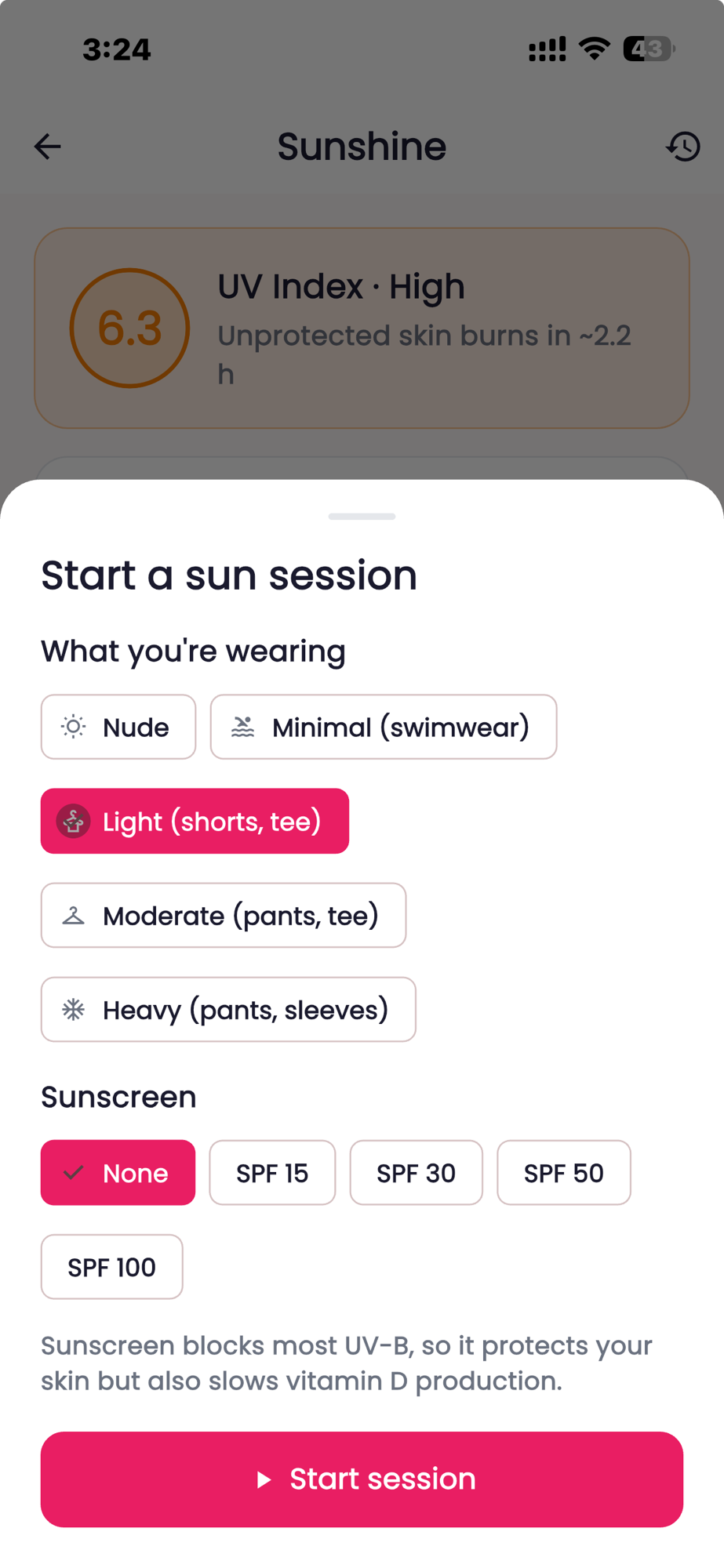
Pick what matches reality and tap Start session.
Step 2: Soak, and watch it count
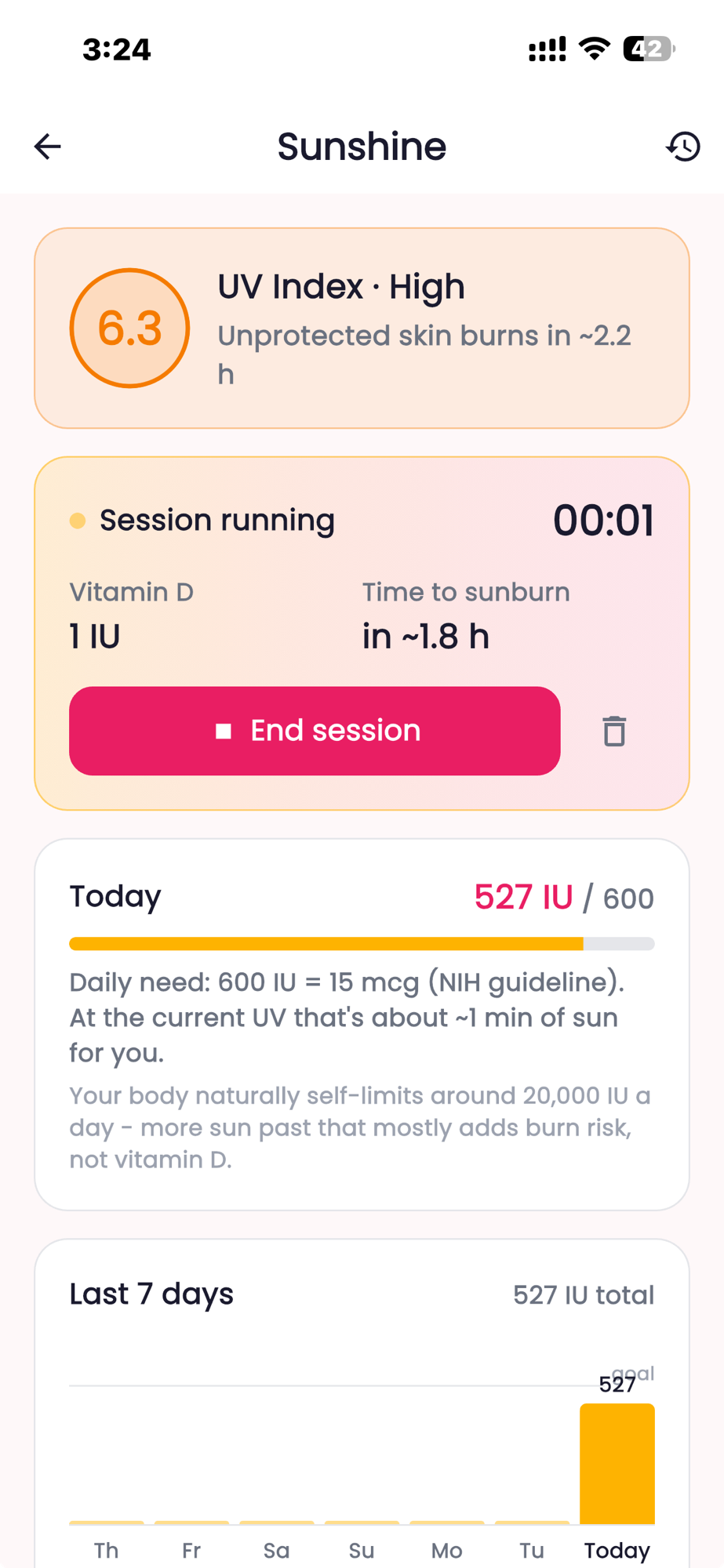
During a session, Femora shows a running timer, the vitamin D you have made so far, and - just as important - the estimated time to sunburn at the current UV for your skin.
You do not need to keep the app open. On iPhone, the session runs as a Live Activity on your lock screen - allow it the first time iOS asks. You can see your IU total ticking up, the current UV, a countdown until you should move to shade, and roughly how long until you hit your daily goal, all without unlocking your phone.
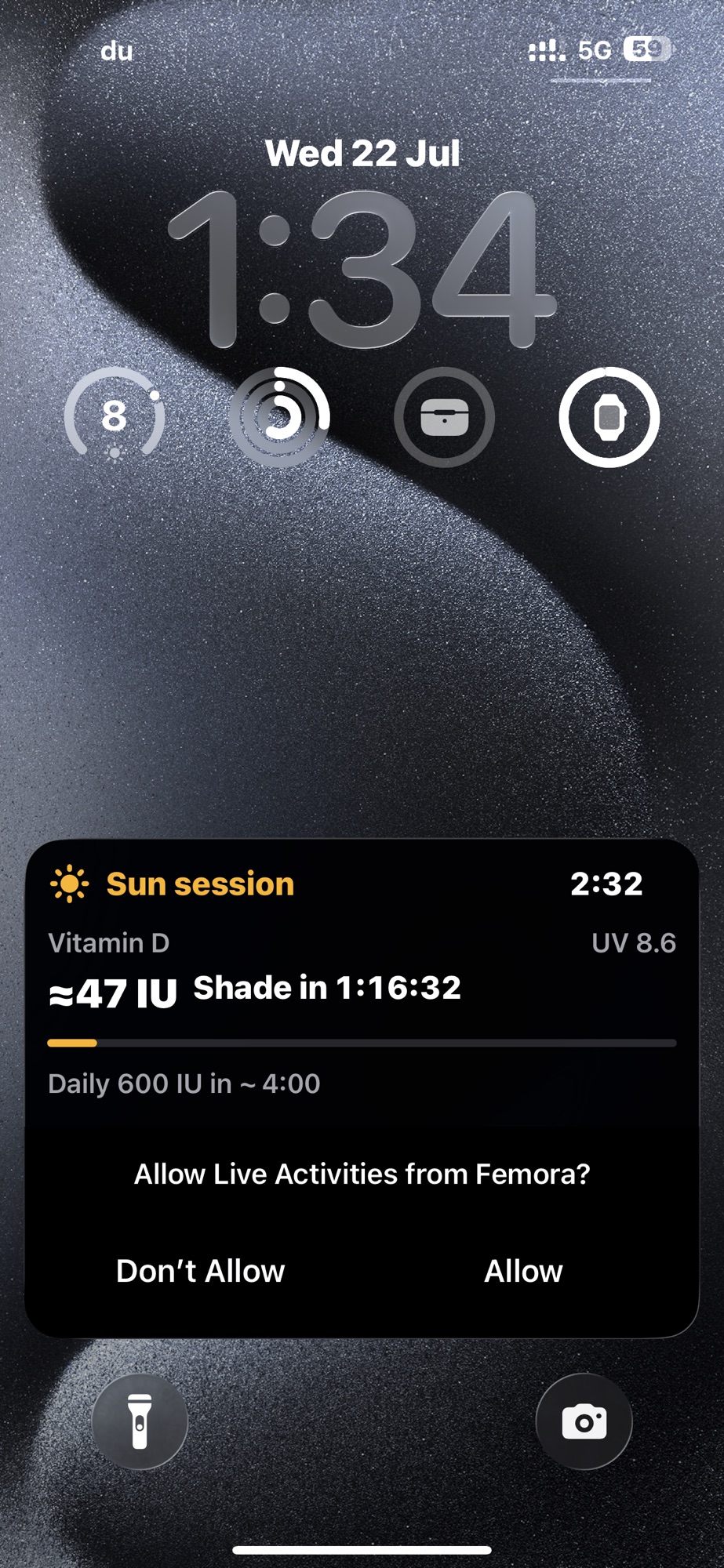
The "shade in" countdown is the safety rail: it is set well inside your estimated burn time, so following it keeps a session useful for vitamin D without drifting into sunburn territory.
Step 3: End the session and bank it
Tap End session when you head in. The vitamin D you made is added to today's total and your 7-day history, so you can see at a glance whether this was a one-off sunny lunch or a real habit forming.
If you use Apple Health, flip on Save to Apple Health and each session's vitamin D is written to Health automatically when it ends - alongside your cycle data Femora already syncs.
The numbers behind the estimates
A few reference points Femora uses, so the figures on screen make sense:
- 600 IU (15 mcg) a day is the NIH recommended intake for most adults, including during pregnancy and breastfeeding. If you ever need to translate IU to mcg for a supplement label, our vitamin D converter does it instantly.
- Your skin self-limits. Extended sun does not keep adding vitamin D forever - your body caps production somewhere around 20,000 IU a day, and past that point extra sun mostly adds burn risk, not vitamin D. More on this in how much sun you actually need.
- The UV index drives everything. Below roughly UV 3, vitamin D production is slow to negligible; at high UV you may make your day's worth in minutes. That is also why sunscreen and shade decisions matter so much more at UV 8 than UV 3.
What Sunshine is not
Sunshine is an estimate engine, not a lab test or a license to tan. The IU figures are modeled from published synthesis research, not measured from your blood, and no app can see your actual vitamin D level - if you suspect a deficiency, the signs are worth knowing and a blood test settles it. And the burn countdown is there so you respect it: a sunburn is never a fair trade for vitamin D.
This is general information about an app feature, not medical advice. If you take photosensitizing medication, have a history of skin cancer, or have been told to avoid sun exposure, follow your clinician's advice.
It's included
Sunshine is part of Femora - the same subscription that covers cycle tracking, predictions, medication reminders, and chat with a health expert. Download Femora and take your first sun session: https://femora.app/download/
Sources
- Vitamin D - Fact Sheet for Consumers - National Institutes of Health, Office of Dietary Supplements.
- Radiation: The ultraviolet (UV) index - World Health Organization.
- UV Index Scale - US Environmental Protection Agency.