Seed Cycling for Hormones: What It Is and What the Evidence Says
Seed cycling means eating flax and pumpkin seeds in the first half of your cycle and sesame and sunflower seeds in the second half to support hormones. The evidence is limited and mostly low quality, so treat it as a harmless, nutritious food habit rather than a proven hormone treatment.
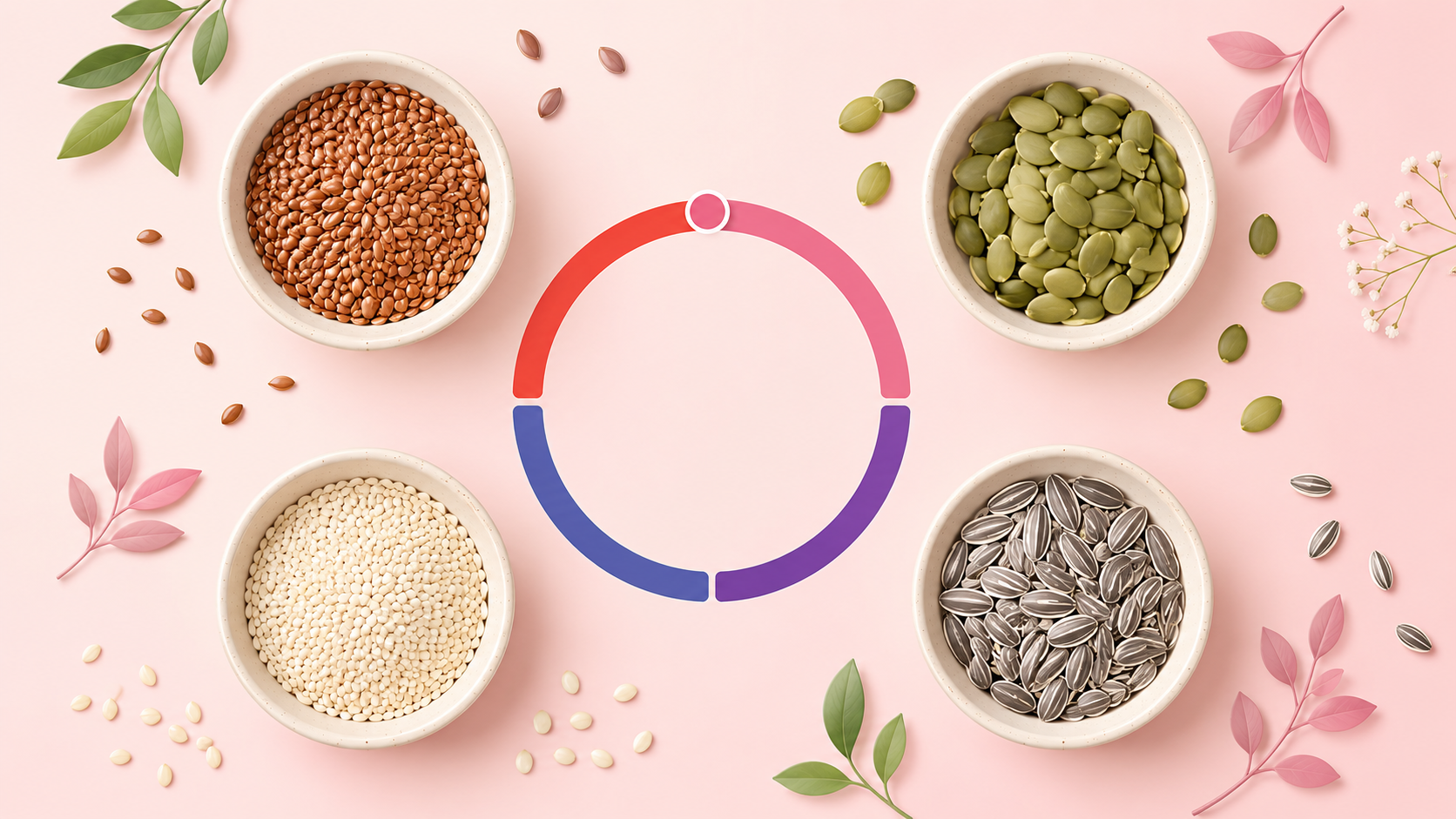
Scroll through wellness content for five minutes and you will meet seed cycling: four seeds, two phases, and a promise to "balance your hormones" naturally. It is cheap, food-based, and easy to try, which is a big part of the appeal.
It is also one of those trends where the confidence of the claims runs far ahead of the evidence. This article walks through exactly what seed cycling is, the theory behind it, what the research actually shows, and an honest answer to whether it is worth your time.
What seed cycling is
Seed cycling is the practice of eating specific seeds during specific halves of your menstrual cycle, with the idea of supporting the hormones that dominate each half.
The cycle is split into two phases at ovulation:
- Follicular phase - from the first day of your period until ovulation, roughly the first half. This is the estrogen-led half.
- Luteal phase - from ovulation until your next period, roughly the second half. This is the progesterone-led half.
The standard protocol is:
- Follicular phase (days 1 to ~14): 1 tablespoon of ground flaxseed + 1 tablespoon of pumpkin seeds daily.
- Luteal phase (days ~15 to 28): 1 tablespoon of sesame seeds + 1 tablespoon of sunflower seeds daily.
If you do not have a regular cycle, most guides tell you to follow the phases of the moon instead: new moon to full moon as the "follicular" half, full moon to new moon as the "luteal" half. That detail alone is a useful clue about how much rigorous science sits underneath the practice.
The theory behind it
The reasoning goes like this. Flax and pumpkin seeds are rich in lignans and zinc, which are said to gently support estrogen in the first half and prime the body for progesterone. Sesame and sunflower seeds provide lignans, vitamin E, and selenium, which are said to support progesterone in the second half.
Lignans are a type of phytoestrogen - a plant compound with a weak, estrogen-like structure. In the body they can bind to estrogen receptors and exert a mild effect, which is the kernel of biological plausibility the whole practice rests on.
The leap that seed cycling makes is from "these seeds contain compounds that can weakly interact with hormones" to "eating them on a schedule will meaningfully rebalance your cycle." That leap is where the evidence gets thin.
What the evidence actually shows
Here is the honest summary: there is very little research on seed cycling as a complete protocol, and what exists is small and low quality. Most of the support comes from studies on individual seeds, especially flaxseed, rather than the four-seed rotation itself.
The single most-cited study is from 1993. Phipps and colleagues had 18 normally cycling women add 10 grams of flaxseed powder a day and found a modestly longer luteal phase and a higher progesterone-to-estrogen ratio during that phase. It is a real, peer-reviewed finding, but it is one tiny study, it tested flaxseed alone rather than seed cycling, and it has not been convincingly replicated at scale.
A 2025 systematic review in Cureus pulled together the seed cycling literature for premenstrual syndrome and PCOS: 10 studies covering about 635 women. The authors found seed cycling looked "promising," with some reported improvements in menstrual regularity, hormone profiles, and metabolic markers. But they were direct about the caveats: small sample sizes, moderate-quality evidence, heavy reliance on self-reported outcomes, short study durations, most trials clustered in a few regions, and no long-term safety data. Their conclusion was that larger, better-designed trials are needed before anyone can call it effective.
In plain terms: not disproven, but nowhere near proven. No major medical body recommends seed cycling as a treatment for hormonal conditions, and the strongest honest statement the current data supports is "it might help some people a little, and it probably will not hurt."
What is actually true: the seeds are genuinely good food
Here is the part that gets lost in the hype-versus-debunking fight. Even if the "cycling" schedule does nothing special, the four seeds are legitimately nutritious:
- Flaxseed - fiber and omega-3 ALA; ground flax is linked in its own right to better cycle regularity in some studies and to reduced breast tenderness.
- Pumpkin seeds - magnesium and zinc, both of which matter for people who get PMS symptoms.
- Sesame seeds - lignans, calcium, and healthy fats.
- Sunflower seeds - vitamin E and selenium.
Adding a couple of tablespoons of ground seeds to your day means more fiber, more magnesium, and more healthy fats than most people currently get. Those are real benefits, and you get them whether or not you time the seeds to your cycle. That is the most defensible reason to try seed cycling: not because the schedule is magic, but because it is a simple habit that nudges your diet in a genuinely healthier direction.
Who might consider it, and who should not rely on it
Seed cycling is reasonable to experiment with if you are generally well, curious, and want an easy way to eat more seeds. It is low cost and low risk for most people.
It is not a substitute for medical care, and you should not lean on it if you have red-flag symptoms. See a clinician rather than reaching for seeds if you have:
- Periods that suddenly become very heavy, very painful, or highly irregular
- Missed periods when you are not pregnant
- Signs of PCOS such as irregular cycles with acne or excess hair growth
- Any symptom that is new, worsening, or interfering with your life
Conditions like PCOS, thyroid disorders, and endometriosis need a proper diagnosis and evidence-based treatment. Seeds are a fine addition to a healthy diet, but they are not a treatment plan. If you take blood thinners or hormone-sensitive medication, or you are pregnant or breastfeeding, check with your clinician before adding large amounts of flaxseed, since it is a potent source of phytoestrogens and fiber.
How to try it safely if you are curious
- Grind the flaxseed. Whole flax passes through you largely undigested; ground flax is what releases the lignans and omega-3s.
- Start with 1 tablespoon of each seed for the relevant phase, stirred into yogurt, oatmeal, smoothies, or salads.
- Track your phase so you actually know when to switch seeds. This is where a cycle app earns its place - guessing "roughly day 14" defeats the point.
- Drink enough water. You are adding a meaningful amount of fiber; ramp up gradually to avoid bloating.
- Give it a few cycles and keep notes. If you feel better, great. If nothing changes after two or three months, you have lost nothing but a little grocery money.
- Do not delay care for real symptoms while you wait to see if seeds help.
How Femora helps
Seed cycling only makes sense if you know which phase you are in, and that is exactly what Femora is built for. The app tracks your follicular and luteal phases from your logged periods, so you know when to switch from flax and pumpkin to sesame and sunflower without counting days on a calendar.
You can also log symptoms like bloating, mood, and cramps alongside the habit, so if you do try seed cycling you can see for yourself whether anything actually changes over a few cycles - real data beats a hunch. And if your symptoms point to something that needs more than a diet tweak, you can chat with a health expert inside the app to figure out your next step. It does not replace your doctor, but it helps you ask better questions.
Curious where you are in your cycle right now? Try the free Menstrual Cycle Calculator, or download Femora to track your phases and symptoms in one private place.
Frequently asked questions
Does seed cycling actually balance your hormones? There is no strong evidence that it does. A few small studies, mostly on flaxseed alone, hint at minor effects on the luteal phase and menstrual regularity, but the overall research is limited and low quality. It is best seen as a nutritious food habit, not a proven hormone treatment.
Which seeds do you eat in each phase? Flaxseed and pumpkin seeds during the follicular phase (period start to ovulation), then sesame and sunflower seeds during the luteal phase (ovulation to your next period). The usual dose is 1 tablespoon of each seed per day.
How long until seed cycling works? Guides typically suggest giving it at least three to four cycles. Because the evidence is weak, treat any improvement as a bonus rather than something to expect, and keep notes so you can judge honestly.
Can I do seed cycling if my periods are irregular? You can, but you will not have clear phase boundaries to align the seeds to. Many people default to the lunar-cycle version, though that has no biological basis. If your cycle is irregular enough that you cannot tell your phases apart, that itself is worth discussing with a clinician.
Is seed cycling safe? For most healthy people, yes - it is just food. Caution is warranted if you are pregnant or breastfeeding, take blood thinners or hormone-sensitive medication, or have a seed allergy, mainly because flaxseed is high in phytoestrogens and fiber. When in doubt, check with your clinician.
Sources
- Effect of flax seed ingestion on the menstrual cycle (Phipps et al.) - The Journal of Clinical Endocrinology & Metabolism, 1993.
- Efficacy of Seed Cycling as an Integrative Therapy for Premenstrual Syndrome and Polycystic Ovary Syndrome in Reproductive-Aged Women: A Systematic Review - Cureus (PMC), 2025.
- What Is Seed Cycling? Effects on Hormones and Menopause - Healthline.
- The effects of flaxseed supplementation on metabolic status in women with polycystic ovary syndrome: a randomized open-labeled controlled clinical trial - Nutrition Journal (PMC), 2020.
- Your menstrual cycle - Office on Women's Health.