Why Strength and Mobility Are the Ultimate Health Goals for Women
Last reviewed June 1, 2026 by Dr. Sapna Jadhav, General Physician. Sources from ACOG, NHS, Mayo Clinic, CDC, NICE, NIH, Cochrane, and peer-reviewed journals.
Strength training and mobility are the two highest-leverage health behaviors for women - they preserve bone density, prevent sarcopenia, improve insulin sensitivity, and stabilize mood across the lifespan. WHO and ACSM guidelines call for resistance training on at least 2 days per week covering all major muscle groups, plus daily mobility work; heavier loads at moderate reps (6-12) outperform the 'light weights, high reps' myth, and adaptation is possible at any age.
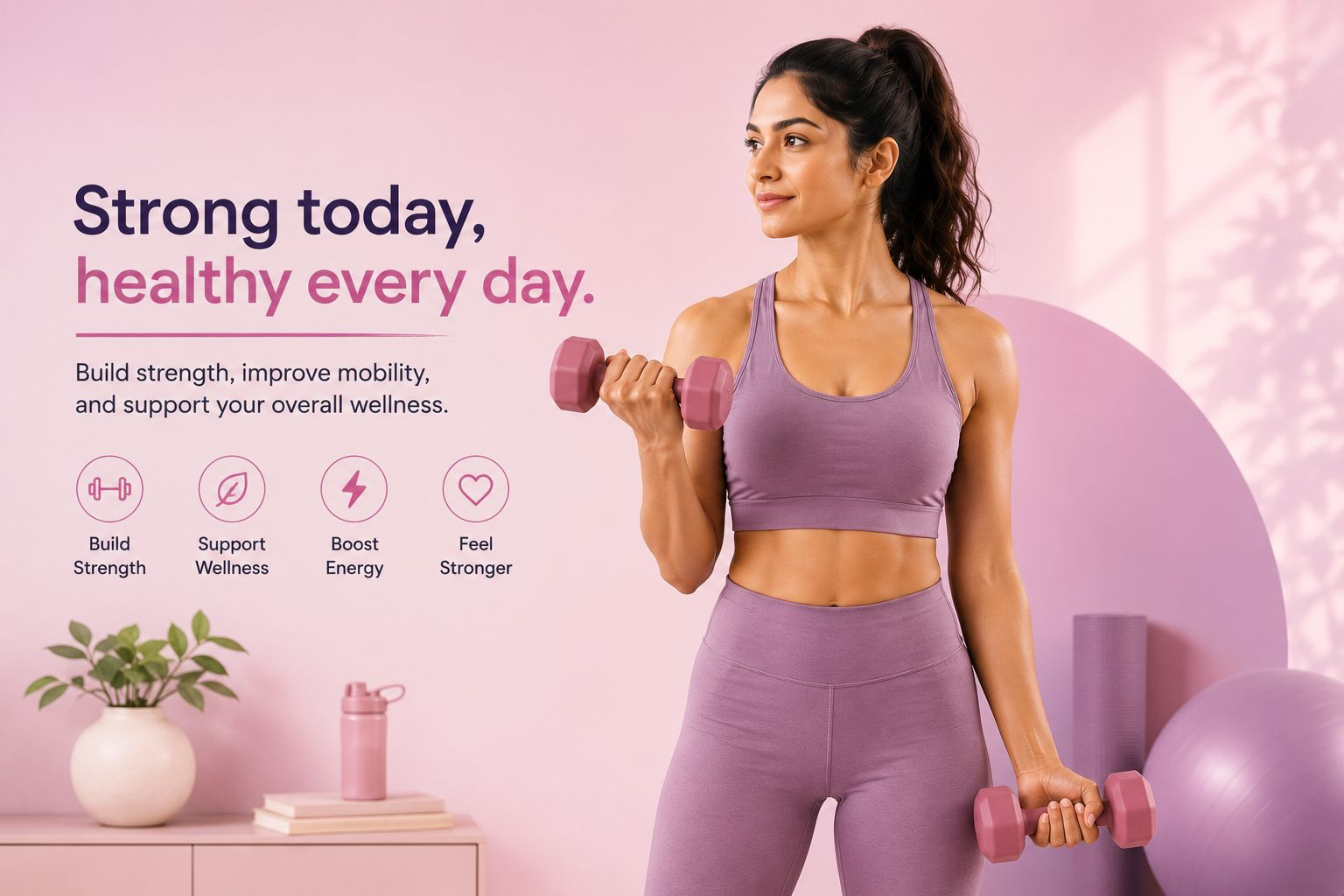
For decades, the dominant fitness message aimed at women has been about getting smaller - lighter weights, more cardio, longer runs, lower numbers. The science has moved on. The evidence from the last fifteen years - reinforced by the WHO's 2020 physical activity guidelines and the U.S. Physical Activity Guidelines for Americans - is unambiguous: the single most consequential health investment most women can make is getting stronger and staying mobile.
Strength and mobility aren't aesthetic goals. They're metabolic, skeletal, hormonal, and cognitive. They protect against the conditions women are most likely to face later in life - osteoporosis, sarcopenia, type 2 diabetes, falls, depression - and they make every other health behavior work better. This guide explains why, what the evidence actually says, and how to start.
What "strength" and "mobility" mean
These two words get used loosely, so it's worth being precise.
Strength is the ability of your muscles to produce force. It's built by lifting loads that are heavy enough to challenge those muscles - typically a weight you can lift 6-15 times before form breaks down. Strength is not the same as endurance, and it's not the same as toning. Toning is a marketing word; muscle either grows and gets stronger or it doesn't.
Mobility is your ability to move a joint through its full, controlled range of motion. It's not the same as flexibility. Flexibility is passive - how far a joint can be pushed. Mobility is active - how far you can take that joint under your own control. A person who can touch their toes with a partner pushing them is flexible. A person who can squat to the floor with their heels down and chest up is mobile.
The two work together. Strength without mobility produces stiff, injury-prone bodies. Mobility without strength produces hypermobile, unstable bodies. The combination is what keeps you moving well across decades.
Why this matters more for women
Men and women both benefit from strength training. The reason it's especially urgent for women comes down to four biological realities.
1. Bone density peaks early and declines fast
Peak bone mass for most women is reached by age 30. After that, bone density slowly declines, and then drops sharply in the years around menopause as estrogen falls. By age 80, roughly one in two women will have experienced an osteoporotic fracture, according to the International Osteoporosis Foundation.
The single most effective non-pharmacological intervention is resistance training combined with weight-bearing impact. Mechanical load on the skeleton signals bone cells to build. Walking is good. Running is better. Lifting heavy with progressive overload is better still. Studies summarized by the National Osteoporosis Foundation and the Mayo Clinic show meaningful gains in bone mineral density at the hip and spine in postmenopausal women who follow structured resistance programs.
2. Muscle mass falls faster than people expect
Sarcopenia - the age-related loss of muscle mass and function - starts in the 30s and accelerates after 60. Women begin with less muscle mass than men on average, so even a moderate decline can push them below the threshold for independent living. The National Institutes of Health and the European Working Group on Sarcopenia have both flagged this as one of the most under-treated drivers of disability in older women.
Strength training is the only intervention with consistent, large-effect-size evidence for preserving and rebuilding muscle at every age, including in women over 80.
3. Insulin sensitivity and metabolic health
Muscle is the largest site of glucose disposal in the body. More muscle means better insulin sensitivity, lower fasting glucose, and a reduced risk of type 2 diabetes and metabolic syndrome - all conditions that disproportionately affect women after menopause and women with polycystic ovary syndrome (now renamed PMOS).
The American Diabetes Association's 2026 Standards of Care explicitly include resistance training (2-3 sessions per week) as a first-line intervention for glycemic control. For women with PCOS / PMOS, the evidence is even stronger: structured strength work improves insulin signaling more reliably than cardio alone.
4. Hormonal and mood effects
Resistance training raises growth hormone and IGF-1, supports estrogen and progesterone balance through indirect metabolic pathways, and produces robust improvements in depressive symptoms across multiple meta-analyses. The mental-health benefit alone would justify the practice; the metabolic and skeletal benefits are layered on top.
What the evidence actually recommends
The headline numbers, from the major guideline-setting bodies:
- WHO Global Physical Activity Guidelines (2020): Adults should do muscle-strengthening activities involving all major muscle groups on 2 or more days per week, in addition to 150-300 minutes of moderate aerobic activity or 75-150 minutes of vigorous activity.
- U.S. Physical Activity Guidelines for Americans, 2nd edition: Same target - 2+ days of resistance training, all major muscle groups.
- American College of Sports Medicine (ACSM): 2-3 non-consecutive days per week of resistance training, 8-10 exercises covering major muscle groups, 8-12 repetitions per exercise, 1-3 sets each. For older adults, an emphasis on power (moving the weight quickly on the concentric phase) is added.
- NHS (UK): Strength activities on at least 2 days per week, plus 150 minutes of moderate activity. Specifically calls out "carrying heavy shopping bags" and "yoga" alongside gym work - the point is loading the muscles, not the venue.
Translation: two short, focused strength sessions a week clears the bar. Three is better. The exercises that matter most cover the patterns you actually use - squat, hinge (deadlift), push, pull, carry, and rotate.
What "mobility work" looks like in practice
Mobility isn't a separate sport. It's a set of patterns layered into how you already train.
- Daily floor sitting and getting up. Sitting cross-legged on the floor and standing without using your hands is one of the strongest predictors of all-cause mortality in adults - the "sit-rising test" used in geriatric research. Practice it.
- Full-range strength exercises. A squat to the floor trains more mobility than a hundred dedicated stretches. A push-up that descends to the chest trains shoulder mobility under load.
- Carries. Loaded carries (suitcase carry, farmer's carry) build grip, core, shoulder, and gait stability simultaneously. Two minutes of carries does more for posture than a week of corrective exercises.
- Hip openers and ankle work. Pigeon, 90-90, deep squat holds, banded ankle distractions - five to ten minutes daily, done while watching television, compounds.
- Cervical and thoracic mobility. Modern desk and phone use shortens the front of the neck and stiffens the upper back. Reverse it with daily t-spine extensions over a foam roller and chin tucks.
Common myths worth retiring
"Lifting will make me bulky." Building visible, substantial muscle mass requires high training volume, hyper-caloric nutrition, and years of consistency. Most women who start lifting describe the change as "more shape, less fluff," not "bigger." Female physiology - particularly the much lower testosterone levels - means hypertrophy happens slowly.
"I should stick to light weights and high reps." This is the most stubborn myth in women's fitness. The strongest stimulus for muscle preservation and bone loading comes from heavier loads at moderate reps (6-12). Light weights have a place - for warm-ups, rehabilitation, and certain isolation work - but they shouldn't be the whole program.
"Cardio is enough." Cardio is wonderful and necessary - it improves cardiovascular health, mood, and metabolic flexibility. It does not preserve muscle mass, does not load the skeleton meaningfully, and does not maintain functional strength into older age. The two are not interchangeable.
"I'm too old to start." Studies in nursing-home residents in their 80s and 90s show meaningful strength gains within 8-12 weeks of progressive resistance training. There is no upper age limit for adaptation.
"Mobility means stretching." Passive stretching has its place but does not transfer to functional movement nearly as well as full-range strength work and active mobility drills. If you have 30 minutes, spend 20 on strength and 10 on mobility, not the reverse.
A simple way to start
If you've never lifted, the first three months are about pattern, not load.
- Two sessions per week, 30-45 minutes each. Non-consecutive days. Keep them on the calendar like medical appointments.
- Six exercises per session. Pick one from each pattern: squat, hinge, push, pull, carry, and one core exercise (plank, dead-bug, side-plank).
- Two to three sets of 8-10 reps per exercise. The last 2 reps should feel hard. If they don't, the weight is too light.
- Progressive overload, not progressive intensity. Add a small amount of weight (2-5 lb) when a session feels manageable across all sets. Don't chase soreness.
- Five minutes of mobility before, five minutes after. Cat-cow, hip 90-90, world's greatest stretch, ankle circles, thoracic rotation. Same five every session is fine.
- One walk per day. Aerobic base separate from strength sessions. 20-30 minutes counts.
You don't need a gym. A pair of adjustable dumbbells, a kettlebell, and a yoga mat covers everything in the list above for under $200. Bodyweight-only programs (push-up progressions, single-leg squats, hip hinges with a backpack) work too, especially in the first 6-8 weeks.
How Femora helps
Strength and mobility don't live in a vacuum - they interact with the rest of your cycle and hormonal life. Femora is built to help you see the patterns:
- Daily symptom logging lets you spot which workouts leave you energised and which leave you drained, and how those patterns track your cycle phase.
- Cycle-phase insights flag the days when most women train best (typically follicular and early ovulatory) and the days where intensity often dips (premenstrual and menstrual). The point isn't to back off training during your period - many women perform fine - but to know what's signal and what's hormone-driven.
- Menstrual Cycle Calculator and Ovulation Calculator map where you are in the cycle so you can plan harder sessions and recovery weeks accordingly.
- BMI Calculator for an initial body-composition baseline, with the same caveat the CDC uses - BMI is a screening tool, not a verdict.
- Perimenopause Quiz for readers in their 40s thinking about how strength work fits into the menopause transition.
For deeper reading on related topics, see the Healthy Pregnancy Guide (which covers safe activity through pregnancy) and the Perimenopause and Menopause 2026 Guide (which covers the bone- and muscle-loss window in detail).
The bigger picture
The most useful frame for women's health planning isn't "look a certain way at 35." It's "stay independent, mobile, and metabolically healthy at 75." The intervention with the most evidence for getting you there isn't a diet, an app, or a wearable. It's lifting heavy things twice a week and moving your joints through their full range every day.
Everything else - sleep, nutrition, cycle tracking, stress management - works better when those two pieces are in place. They're not optional. They're not "for athletes." They're the floor.
Track your training, symptoms, and cycle patterns alongside your strength work with Femora - free on iOS and Android.
Sources
- WHO Guidelines on Physical Activity and Sedentary Behaviour - World Health Organization, 2020.
- Physical Activity Guidelines for Americans, 2nd edition - U.S. Department of Health and Human Services, 2018.
- ACSM Guidelines for Exercise Testing and Prescription - American College of Sports Medicine.
- Exercise for Your Bone Health - NIH Osteoporosis and Related Bone Diseases National Resource Center.
- Strength training: Get stronger, leaner, healthier - Mayo Clinic.
- Exercise guidelines for adults aged 19 to 64 - NHS.
- Osteoporosis and Bone Mineral Density - International Osteoporosis Foundation.
- Sarcopenia: revised European consensus on definition and diagnosis - Age and Ageing (Oxford Academic), 2019.
- Resistance Exercise Training: Its Role in the Prevention of Cardiovascular Disease - Circulation (American Heart Association), 2023.
- 5. Facilitating Positive Health Behaviors and Well-being: Standards of Care in Diabetes - 2026 - Diabetes Care (American Diabetes Association), 2026.