Perimenopause to Postmenopause: A Plain-English Guide to the Four Stages
Last reviewed May 31, 2026 by Dr. Sapna Jadhav, General Physician. Sources from ACOG, NHS, Mayo Clinic, CDC, NICE, NIH, Cochrane, and peer-reviewed journals.
Perimenopause is the hormonal transition before your last period - spanning up to a decade - while menopause itself is defined by 12 consecutive period-free months. As of 2026, the consensus is that hormone therapy is effective for moderate-to-severe vasomotor symptoms in women under 60 or within 10 years of menopause, with post-WHI re-analyses showing a substantially more favorable benefit/risk profile than earlier warnings suggested.

For decades, "menopause" got treated as a single event - one moment in time when periods stop. That framing skipped over the part most people actually experience: the four-to-eight-year transition before it, and the decades of life after it, where hormone levels, sleep, mood, cognition, and metabolism all keep shifting.
The medical world has been catching up. In October 2025, the European Society of Endocrinology published its first comprehensive clinical practice guideline on menopause and perimenopause - explicitly framing menopause as a spectrum, not a single date. In November 2025, the FDA announced it would remove the "black box" warnings from menopausal hormone therapy products, reversing 20+ years of post-Women's-Health-Initiative caution that had scared a generation of women away from treatment that could have helped them. The first batch of six relabeled products was approved in February 2026.
This guide walks through what those four stages actually are, what symptoms to expect at each, what the FDA change means for hormone therapy, and what to track if you suspect you're in transition.
The four stages
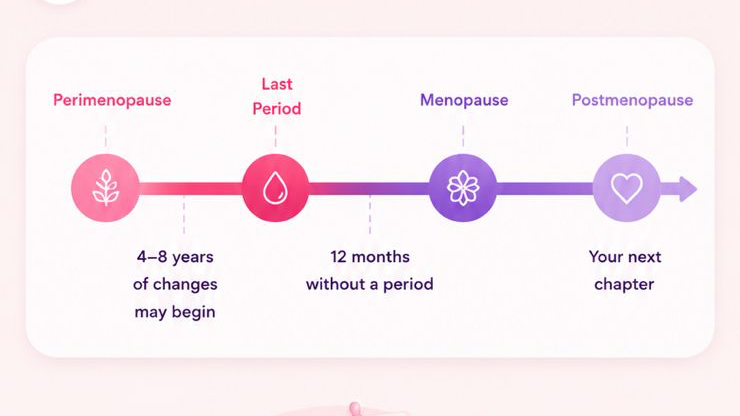
1. Perimenopause
The transition phase. Hormones - particularly estrogen and progesterone - start fluctuating unpredictably, and your cycles begin to change. This can start as early as your mid-30s and typically lasts 4 to 8 years, though for some people it stretches to 10.
The defining feature of perimenopause is irregularity. Cycles get shorter or longer. Periods get heavier or lighter. Symptoms appear, disappear, and re-appear. The unpredictability itself is the diagnosis.
2. Last period
Your "final menstrual period" - the literal last bleed you'll have. You only know it was the last one retrospectively, after 12 consecutive period-free months. Until then, you're still technically in perimenopause.
The average age in the US and UK is 51, but the normal range is roughly 45 to 55. Earlier than 45 is called "early menopause"; before 40 is "premature ovarian insufficiency" and needs medical evaluation.
3. Menopause
A specific moment in time, not a phase: 12 consecutive months without a period. Once that 12-month mark passes, you are - by definition - menopausal. From that day forward you're in the next stage.
This is the part that surprises a lot of people. "Menopause" is a single day, not a season.
4. Postmenopause
Everything after that 12-month mark, for the rest of your life. Hormone levels stabilize at a new, lower baseline. Many symptoms ease - but not all. Risks shift toward bone density loss (osteoporosis), cardiovascular disease, and genitourinary syndrome of menopause (GSM).
Perimenopause symptoms to expect
The list is long because the hormonal swings affect almost every system. You will not get all of these. Most people have a distinctive cluster of 4–7 that show up repeatedly.
Cycle and bleeding
- Cycle length changes - shorter cycles often come first, then longer or skipped ones
- Heavier periods (or sometimes lighter)
- Spotting between periods
- Cycles that vary wildly month-to-month - the hallmark sign
Vasomotor (hot flashes and chills)
- Hot flashes - sudden waves of heat, often in the face and chest
- Night sweats - drenching sweat that disrupts sleep
- Cold flashes - less talked about but real
- Affects roughly 75% of women during perimenopause
Sleep
- Difficulty falling asleep despite tiredness
- Waking at 3–4am and not getting back to sleep
- Lighter, less restorative sleep even when total hours look normal
Mood and cognition
- Anxiety that feels disproportionate to circumstances
- Low mood or depression - sometimes first-time, sometimes a flare of pre-existing
- Irritability and a shorter fuse
- "Brain fog" - word-finding pauses, lost trains of thought, harder multitasking
Body and skin
- Joint aches - particularly hands, knees, hips
- Weight redistribution toward the abdomen, even without weight gain
- Skin dryness and thinning
- Hair thinning at the crown
- Increased facial hair (estrogen drops while androgens stay)
Genitourinary
- Vaginal dryness
- Painful intercourse
- Urinary urgency or recurrent UTIs
- Reduced libido
Other
- Heart palpitations that feel alarming but are usually benign
- Migraines - new onset or change in pattern
- Breast tenderness without the cyclical pattern you used to have
What the FDA changed in February 2026
For 20+ years, every menopausal hormone therapy product carried a "black box" warning - the FDA's most serious safety label - citing risks of cardiovascular disease, breast cancer, and probable dementia. Those warnings were rooted in early interpretations of the Women's Health Initiative (WHI) study published in 2002, which scared a generation of clinicians and patients away from hormone therapy.
The problem: the WHI studied women whose average age was 63 - already 12 years past the average age of menopause. Subsequent re-analyses showed the risks looked very different for women starting HRT within 10 years of menopause (the "timing hypothesis"). For that earlier-starting group, randomized data show reduced all-cause mortality and fewer fractures.
In November 2025, the FDA announced it would remove those boxed warnings. On February 12, 2026, the first six relabeled products received approval. The risk statements about cardiovascular disease, breast cancer, and probable dementia are gone from the boxed warning. (The warning for endometrial cancer in estrogen-alone products is kept - that one is well-supported.)
Twenty-nine drug companies have submitted proposed labeling changes; the rollout will continue through 2026.
What this means in practice
- HRT is back on the table for many people who were previously told it was too risky.
- The "timing hypothesis" - starting HRT within 10 years of menopause, generally before age 60 - is now broadly accepted.
- This does not mean HRT is right for everyone. People with a history of breast cancer, certain clotting disorders, or active cardiovascular disease still face genuine risks. The change reframes the conversation, not the medical evaluation.
If your doctor told you 5 years ago that hormone therapy was too dangerous to consider, it's worth a second conversation.
What the 2025 European guideline added
In October 2025, the European Society of Endocrinology published its first comprehensive clinical practice guideline on menopause and perimenopause. The key shifts:
- Menopause is a spectrum. The guideline explicitly recommends treating perimenopause and postmenopause as part of a continuous process - not three disconnected stages.
- Multiple treatment options for hot flashes. Menopausal hormone therapy (MHT), combined hormonal contraceptives, or estrogen plus a levonorgestrel-releasing IUD are all recommended first-line for vasomotor symptoms.
- Local treatment for genitourinary symptoms. Low-dose vaginal estrogen, vaginal DHEA, or oral ospemifene for symptoms that don't respond to nonhormonal options.
- Premature ovarian insufficiency (POI) gets a dedicated pathway. Menopause before age 40 needs different evaluation and longer-term hormone support.
- For women with breast cancer history or high risk, the guideline provides specific nonhormonal pathways rather than dismissing them with "no HRT, sorry."
What to track if you suspect you're in perimenopause
Perimenopause has no single diagnostic test. Blood hormone levels swing too wildly to confirm or rule out the diagnosis on a single draw. What clinicians actually rely on is a pattern over time - and that is exactly what daily logging gives you.
What to capture:
- Cycle length - every period start and end date for at least 6 months
- Flow heaviness - light, medium, heavy, very heavy
- Symptom frequency and intensity - hot flashes per day, night sweats per week, brain fog severity
- Sleep quality - hours, wake-ups, time to fall asleep
- Mood - daily check-in, with notes when something stands out
- Joint aches, headaches, palpitations - anything that's new or changed
Bring 3–6 months of this data to your appointment. "My cycles have been irregular for a year and here's the pattern of vasomotor symptoms" is a far stronger case than "I think something is off."
How Femora helps
Femora's perimenopause flow (built around the four-stage model above) and daily symptom logging are designed for exactly this kind of long-form tracking:
- Stage-aware tracking - the app recognizes that perimenopause cycles will be irregular by design and won't pester you with "missing period" alerts the way standard cycle trackers do
- Symptom logging for hot flashes, night sweats, sleep quality, mood, joint pain, and brain fog
- Pattern visualization so you can see month-over-month trends rather than fighting day-to-day noise
- Exportable history for doctor visits
If you're still cycling regularly but want to track the early signs, start with the Period Calculator and pair it with daily logs. If your cycles are already irregular, focus on symptom logging - irregularity itself is the data.
Not sure which stage you're in? Run the free Perimenopause Quiz - eight questions on cycle, sleep, mood, hot flashes, and brain fog that map your answers to the four-stage model above and surface a clear list to bring to a doctor.
When to see a doctor
Some perimenopause experiences need medical attention, not just tracking:
- Bleeding after 12 period-free months - always evaluate
- Periods more than 7 days long, or heavy enough to soak through a pad/tampon hourly
- Cycles shorter than 21 days or longer than 35 days persistently
- Migraines, palpitations, or mood changes that interfere with daily life
- Hot flashes severe enough to disrupt sleep, work, or relationships
- Vaginal dryness causing painful intercourse
- Suspected perimenopause before age 40 - always evaluate
For all of these, the 2025/2026 guidelines give clinicians more treatment options than they had a year ago. Don't accept "this is just your age" as a plan.
The bigger picture
Two decades of women were told that hormone therapy was too dangerous, that their symptoms were psychosomatic, and that perimenopause "wasn't really a thing." All three of those messages were medically wrong. What's happening in 2025/2026 - the FDA relabeling, the European guideline, the broader cultural shift led by clinicians like Dr. Mary Claire Haver and Dr. Jen Gunter - is a slow correction.
If you're in perimenopause now, you're entering this stage at the best moment in modern history to be heard. There are more treatment options on the table, fewer black-box warnings standing in the way, and a growing recognition that this transition is worth taking seriously.
Track your cycle, symptoms, mood, and sleep through the entire transition with Femora. Free on iOS and Android. The more data you bring to your appointments, the better your care.
Sources
- Menopause and perimenopause - NHS.
- Symptoms of menopause and perimenopause - NHS.
- Menopause: identification and management (NG23) - NICE, 2015.
- Menopause - Office on Women's Health.
- Hormone Therapy for Menopause - ACOG.
- Hormone Therapy | The Menopause Society - The Menopause Society.
- Menopausal Hormone Therapy - Risks, Benefits and Emerging Options: A Narrative Review - PubMed Central / International Journal of Molecular Sciences, 2025.