A Healthy Pregnancy: Your Body, Your Baby, and Staying Active
Last reviewed May 31, 2026 by Dr. Sapna Jadhav, General Physician. Sources from ACOG, NHS, Mayo Clinic, CDC, NICE, NIH, Cochrane, and peer-reviewed journals.
Start prenatal care early, take folic acid daily, eat well, stay active with 150 minutes of moderate exercise per week, and avoid alcohol - then follow along week by week as your body and baby change through three distinct trimesters.
Pregnancy is forty weeks of constant change - for your body, for the baby growing inside you, and for everything you thought you knew about how either one works. This guide walks you through what's happening in each trimester, what's normal, and how to stay strong and comfortable from week one to week forty.
It is not medical advice. Every pregnancy is different, and your OB-GYN or midwife knows your specific situation. Use this as a map, not a prescription.
Your changing body, trimester by trimester
First trimester (weeks 1–12)
This is the trimester where the most happens internally and the least is visible from the outside. Hormones - particularly hCG, progesterone, and estrogen - surge dramatically. That hormonal shift is responsible for most of the early symptoms:
- Fatigue that feels unlike any tiredness you've experienced before
- Nausea (the misleadingly named "morning sickness," which strikes any time of day)
- Tender, fuller breasts
- Frequent urination as blood volume increases and your uterus starts to press on the bladder
- Food aversions and cravings - often sudden and intense
- Mood swings that mirror puberty or PMS, only stronger
Most people don't "look pregnant" yet. The uterus is still tucked behind the pubic bone. Bloating, however, can make clothes feel tight by week 6 or 8.
Second trimester (weeks 13–27)
Often called the "honeymoon trimester." Energy returns for most people, nausea fades, and you start to look - and feel - pregnant.
- Visible bump typically appears between weeks 16 and 20
- First fetal movements ("quickening") usually felt between weeks 18 and 22
- Round ligament pain - sharp twinges in the lower abdomen as ligaments stretch
- Increased appetite as the baby grows faster
- Skin changes - a darker line down the abdomen (linea nigra), darker nipples, and sometimes a "pregnancy glow" from increased blood flow
This is also when most anatomy scans happen (around week 20), and many people choose to find out the baby's sex.
Third trimester (weeks 28–40)
The home stretch - and the part where it really feels like you're carrying another person.
- Braxton Hicks contractions - irregular, painless "practice" tightenings
- Back pain, hip pain, and pelvic pressure as the baby drops lower
- Swelling in the feet, ankles, and hands
- Heartburn and reflux as the uterus pushes the stomach upward
- Shortness of breath until the baby "drops" near the end
- Sleep disturbances - finding a comfortable position becomes a nightly puzzle
The baby is gaining roughly half a pound per week in the final stretch, which is why the third trimester feels exponentially heavier than the second.
How your baby develops
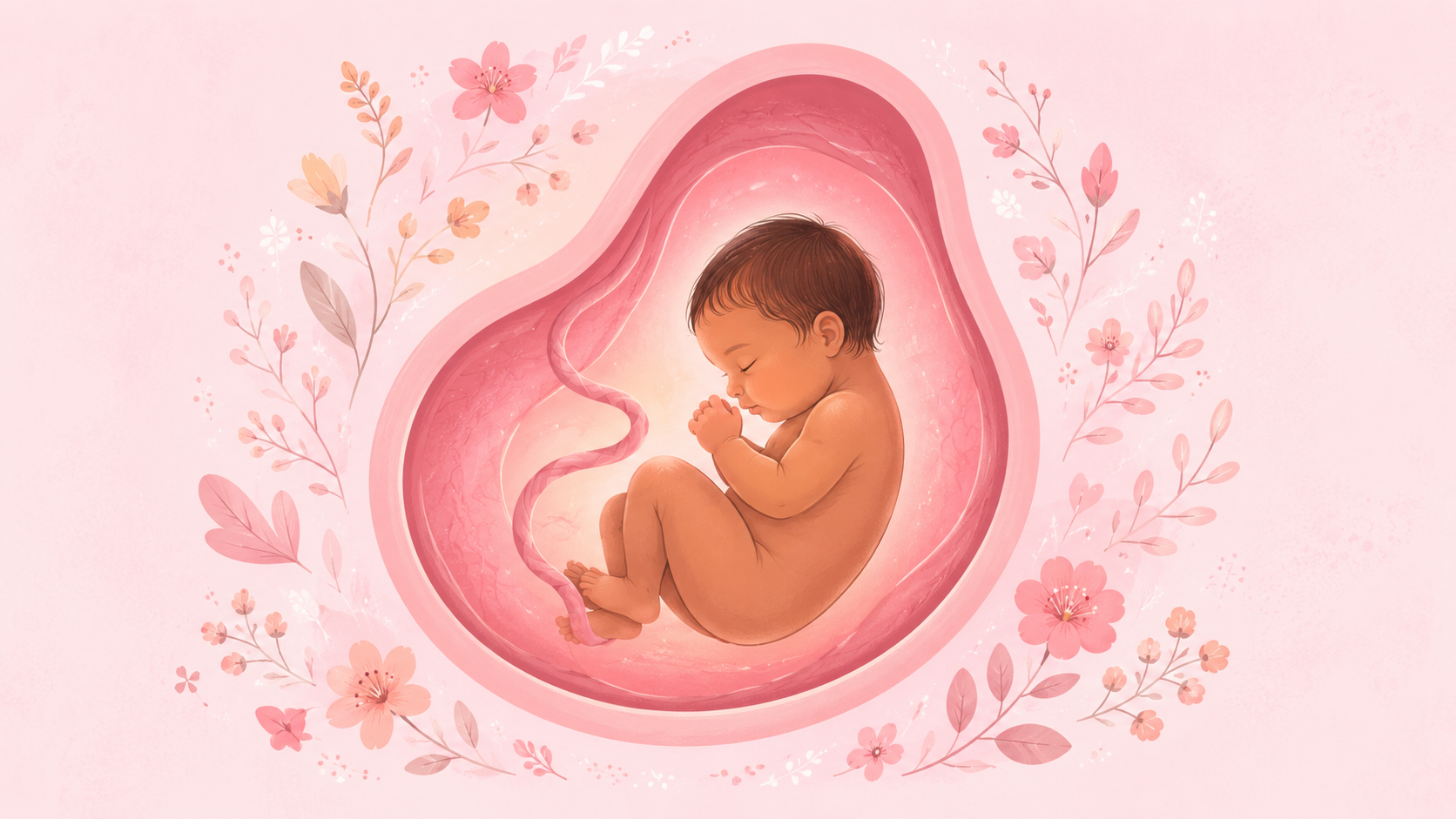
The transformation from a single cell to a fully formed baby is staggering. Here's a high-level view of what's happening on the other side of the bump.
Weeks 1–12: Building the blueprint
By the end of the first trimester, your baby has gone from a microscopic cluster of cells to a recognizable little human, roughly the size of a lime.
- Weeks 4–5: Heart starts to beat (detectable by ultrasound around week 6)
- Weeks 6–8: Arm and leg buds appear; major organs begin forming
- Weeks 9–10: Fingers and toes are distinct; tail disappears
- Weeks 11–12: Sex organs are forming; baby can make tiny movements (though you can't feel them yet)
This is the most vulnerable developmental window. Most miscarriages happen before week 12, and it's when exposure to medications, alcohol, or certain illnesses has the biggest impact.
Weeks 13–27: Growing and practicing
The second trimester is about refinement. The baby's systems are in place - now they're growing, maturing, and practicing.
- Weeks 13–16: Bones harden; baby starts moving more (still too subtle to feel)
- Weeks 17–20: Hair, fingernails, and unique fingerprints develop
- Weeks 21–24: Lungs start producing surfactant; baby can hear your voice
- Weeks 25–27: Eyes open; sleep-wake cycles begin
By week 24, the baby reaches the "viability" milestone - a stage where survival outside the womb becomes possible with significant medical support.
Weeks 28–40: Final preparations
The third trimester is about gaining weight, maturing the lungs and brain, and getting ready to breathe air.
- Weeks 28–31: Brain grows rapidly; baby practices breathing motions
- Weeks 32–35: Bones fully formed but skull stays soft for birth; baby usually flips head-down
- Weeks 36–37: Considered "early term" - lungs nearly mature
- Weeks 38–40: Considered "full term" - baby gains roughly half a pound per week
By week 40, the average baby is around 7.5 pounds and 20 inches long - though "average" hides a wide healthy range.
Staying active: safe exercise during pregnancy
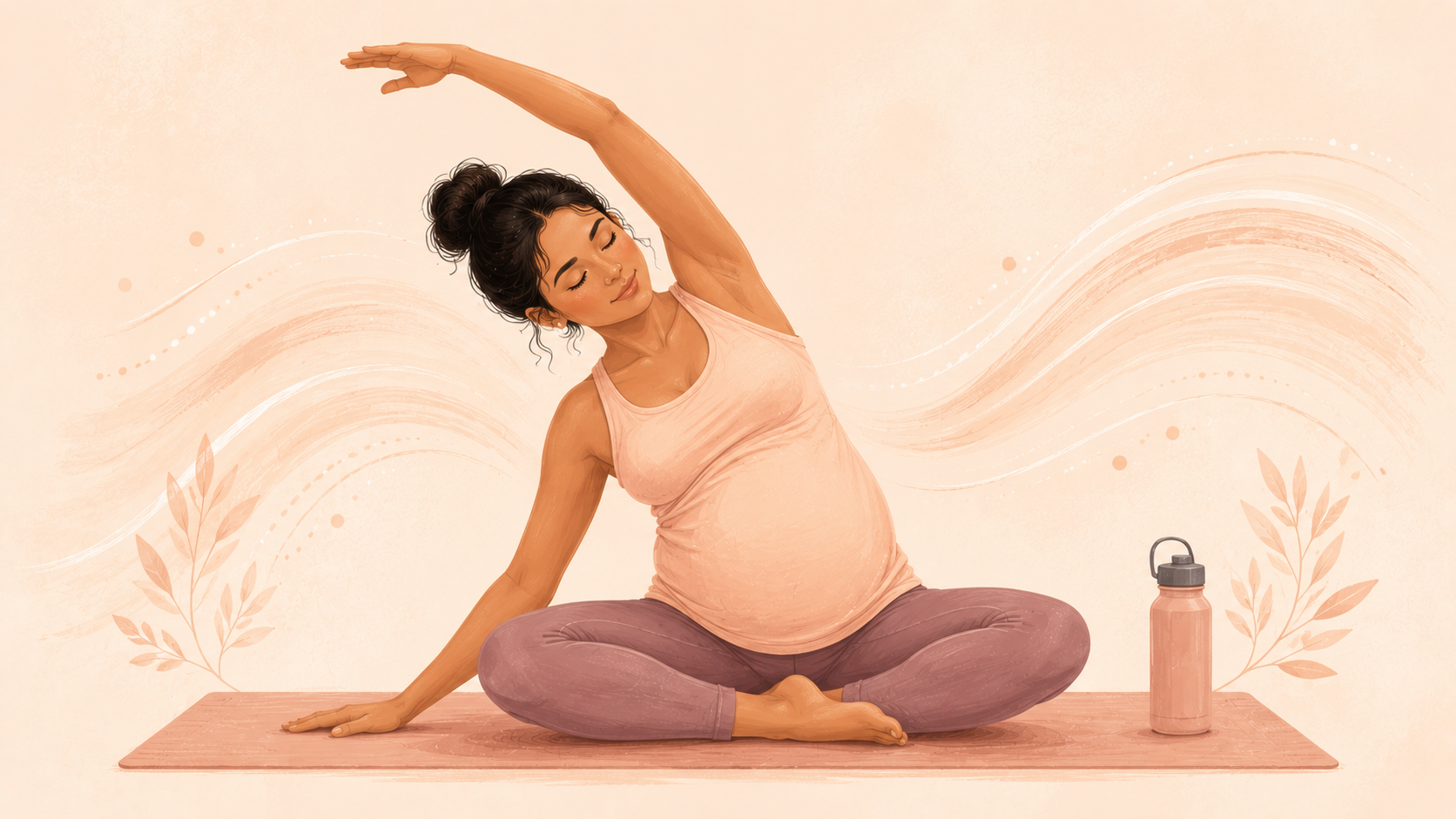
The old "rest and avoid exertion" advice has been replaced. Major health bodies - ACOG, the NHS, the WHO - now recommend that healthy pregnant people get at least 150 minutes of moderate-intensity exercise per week. Staying active improves sleep, reduces back pain, lowers the risk of gestational diabetes and pre-eclampsia, and helps with recovery after birth.
Safe activities (most pregnancies, all trimesters)
- Walking - the simplest and safest cardio for the entire pregnancy
- Swimming and water aerobics - gentle on joints, supports the bump
- Prenatal yoga - focuses on hip mobility, breath work, and stress relief
- Stationary cycling - lower fall risk than road biking
- Light strength training - keeps muscles strong for labor and parenting
- Pelvic floor exercises (Kegels) - vital for delivery and postpartum recovery
What to avoid
- Contact sports - soccer, basketball, martial arts
- High fall-risk activities - skiing, horseback riding, gymnastics
- Scuba diving - pressure changes can harm the baby
- Hot yoga or any exercise that overheats you - body temperature above 102°F can be harmful
- Lying flat on your back after week 16 - the uterus can compress a major vein and reduce blood flow
- Heavy lifting without proper form
Listening to your body
Stop and call your provider if you experience any of these during or after exercise:
- Chest pain or shortness of breath at rest
- Severe headache or dizziness
- Calf pain or swelling (could be a blood clot)
- Vaginal bleeding or fluid leakage
- Regular painful contractions
- Decreased fetal movement after week 28
The "talk test" is a simple gauge: if you can hold a conversation while exercising, you're at a safe intensity. If you can sing, push slightly harder. If you can't speak in full sentences, slow down.
Nutrition essentials
You're not actually "eating for two" - you only need about 340 extra calories per day in the second trimester and 450 in the third. Quality matters more than quantity.
Eat plenty of
- Folate-rich foods - leafy greens, lentils, fortified cereals (critical in early pregnancy for neural tube development)
- Iron-rich foods - lean meat, beans, spinach (paired with vitamin C for absorption)
- Calcium and vitamin D - dairy, fortified plant milks, salmon
- Omega-3 fatty acids - salmon, sardines, walnuts, flaxseed
- Protein - eggs, poultry, tofu, legumes, Greek yogurt
- Water - aim for 10 cups (2.4L) per day
Limit or avoid
- High-mercury fish - shark, swordfish, king mackerel, tilefish
- Raw or undercooked meat, fish, and eggs
- Unpasteurized cheese and dairy
- Deli meats unless heated until steaming
- Alcohol - no known safe amount
- Excess caffeine - most guidelines cap it at 200mg/day (about one 12oz coffee)
- Raw sprouts - high bacterial contamination risk
A daily prenatal vitamin covers the gaps - particularly folate, iron, iodine, and DHA. Start it before conception if possible, and continue throughout pregnancy and breastfeeding.
When to call your doctor
Some symptoms are normal pregnancy weirdness. These are not:
- Heavy vaginal bleeding at any stage
- Severe, persistent abdominal pain
- Sudden swelling of the face or hands, especially with headache or vision changes (signs of pre-eclampsia)
- Fever above 101°F
- Painful urination or signs of a UTI
- No fetal movement for several hours after week 28
- Leaking fluid before week 37
- Regular contractions before week 37
When in doubt, call. Your provider would rather hear from you ten times than miss something important once.
How Femora helps
Femora's pregnancy tools are designed to support you through every week:
- Pregnancy Week Calculator - Enter your last period date and instantly see how far along you are, your estimated due date, and what's happening with your baby this week.
- Weeks to Months Converter - Quick conversion when people ask "how many months are you?"
- Due Date Calculator and Due Date by Ultrasound - Estimated delivery date from your last period or your dating scan.
- IVF & FET Due Date - More precise dating from your embryo transfer date.
- Conception Date Calculator - Useful for confirming gestational age, especially with irregular cycles.
- Maternity Leave Planner - Map your start and return dates so you can plan handover and childcare.
- Hospital Bag Checklist - Interactive checklist with saved progress and a print button - pack by 36 weeks.
- Breastfeeding Calorie Calculator - For the postpartum stretch, when nursing adds 330-400 kcal/day to your needs.
- Symptom tracking in the app - Log nausea, fatigue, cramps, and mood so you can spot patterns and share data with your provider.
Pregnancy is one of the most physically demanding things a body can do. Be patient with yourself, ask for help, and trust that the changes you're feeling - strange as they sometimes are - are usually signs of a body doing exactly what it's supposed to.
Track your pregnancy week by week with Femora - free on iOS and Android.
Sources
- Exercise During Pregnancy - American College of Obstetricians and Gynecologists.
- Healthy pregnancy - Mayo Clinic.
- Keeping well in pregnancy - NHS, 2023-03-15.
- Have a healthy diet in pregnancy - NHS.
- Week-by-week guide to pregnancy - NHS.
- During Pregnancy - CDC.
- Pregnancy - Office on Women's Health.