At-Home Hormone Tests: What AMH, FSH and LH Can (and Can't) Tell You
At-home hormone testing is one of the biggest femtech categories of 2026, but its value depends entirely on which hormone you measure. LH ovulation predictor kits are the genuinely useful at-home test: they detect the surge 24 to 36 hours before ovulation and time your fertile window (though PCOS/PMOS can cause false positives). AMH measures ovarian reserve (egg quantity, not quality, and not your monthly chance of conceiving) and is best used for IVF planning with a clinician, not as a fertility score. At-home FSH menopause strips are about 90% accurate at detecting elevated FSH, but because FSH fluctuates day to day they can't confirm perimenopause, which ACOG says is diagnosed from age, symptoms, and cycle changes without testing. Most hormone tests are only meaningful on specific cycle days, so tracking your cycle is what makes the result interpretable.
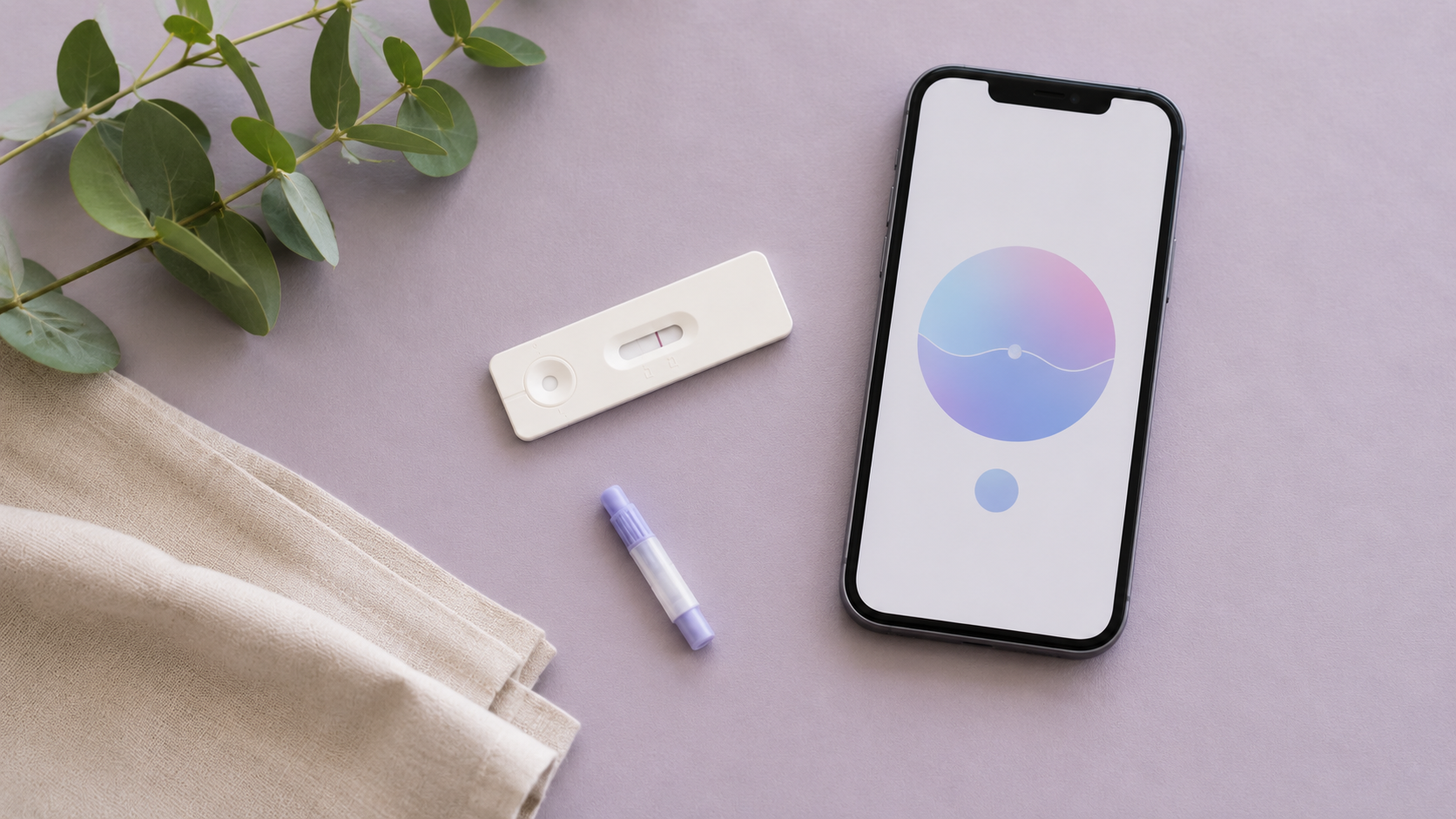
Order a finger-prick kit, mail it back, and get your hormone levels in an app a few days later. At-home hormone testing has gone from niche to one of the biggest femtech categories of 2026, sitting right alongside the smart rings and AI cycle tools also flooding the market.
The pitch is appealing: skip the clinic, get a number, understand your fertility or your menopause status. But a hormone level is only as useful as the question it answers, and the most popular tests are also the most misunderstood.
An LH kit can genuinely time your fertile window. An AMH result is not a fertility score. An FSH strip can't confirm perimenopause. Same category, completely different value.
This guide explains what each at-home hormone test actually measures, what it can't tell you, and how to time it so the number means something.
What an at-home hormone test actually is
Most at-home hormone tests work one of two ways. Urine strips (like ovulation predictor kits) detect a hormone surge at home in minutes. Finger-prick blood kits collect a few drops you mail to a lab, which measures hormones like AMH, FSH, estradiol, thyroid, or testosterone and returns results in an app.
The technology is real and the labs are often the same ones your doctor uses. The catch is interpretation. Hormones swing across your cycle and from day to day, so when you test and which hormone you test decide whether the result is meaningful or noise.
Why people buy them, and where it goes wrong
People reach for these kits to answer big questions: How fertile am I? Am I in perimenopause? Is something wrong with my hormones?
The problem is that the most-marketed tests don't answer those questions cleanly. AMH gets sold as a fertility forecast. FSH strips get sold as menopause confirmation. Both overpromise. Understanding what each hormone genuinely reflects is the difference between a useful conversation starter and false reassurance or needless alarm.
What each hormone test tells you
AMH - ovarian reserve, not a fertility score
Anti-Mullerian hormone (AMH) is made by cells around your developing egg follicles, so it roughly reflects how many eggs you have left (your ovarian reserve). It's the headline at-home fertility test.
What it genuinely helps with: predicting how your ovaries might respond to IVF stimulation, which is why fertility clinics use it.
What it cannot do: tell you your monthly chance of conceiving naturally, your egg quality, or an exact egg count. The American Society for Reproductive Medicine notes that ovarian-reserve markers are poor predictors of natural fertility in women without a known infertility problem. A large 2024 study of over 3,150 women did find that a low AMH (under 1 ng/mL) was modestly associated with a longer time to pregnancy, but the effect was small and the study had real limitations. A reassuring AMH does not guarantee fertility, and a low one does not mean you can't conceive.
The single most important point: AMH is about quantity, not your odds this cycle. Treat it as one input for a clinician, not a verdict.
FSH - a menopause clue that fluctuates too much to confirm it
Follicle-stimulating hormone (FSH) rises as ovarian function declines, which is why at-home menopause kits measure it. These strips are about 90% accurate at detecting an elevated FSH level.
But detection isn't diagnosis. FSH swings from day to day in perimenopause, so a single high reading can't confirm the transition and a normal one can't rule it out. ACOG is explicit: hormone testing is generally not required to diagnose perimenopause, and a clinician can usually tell from your age, symptoms, and cycle changes alone. Read more in our perimenopause and menopause guide.
An FSH strip is a conversation starter, not a confirmation.
LH - the one that genuinely times your fertile window
Luteinizing hormone (LH) is the exception that actually delivers on the at-home promise. Ovulation predictor kits detect the LH surge, which happens 24 to 36 hours before ovulation, giving you real advance warning of your most fertile days.
This is the at-home hormone test most worth using day to day if you're trying to conceive. The caveat: in PCOS/PMOS, LH can run chronically high and produce false positives, so pair it with other signs. See our guide to ovulation symptoms.
Progesterone, thyroid, and the rest
- Progesterone, tested about 7 days after ovulation, can confirm that you ovulated, which only works if you know when you ovulated.
- Thyroid (TSH) and prolactin matter because thyroid problems and high prolactin are common, treatable causes of irregular cycles.
- Testosterone is sometimes checked in a PCOS/PMOS workup.
These are genuinely useful, but almost all of them depend on testing on the right cycle day, which is where tracking comes in.
What this means for you
The honest summary by goal:
Trying to conceive? An LH kit is the high-value at-home test, because it predicts your fertile window. AMH is optional context for a clinician, not a green or red light.
Wondering about perimenopause? Save your money on FSH strips. Your symptoms and cycle changes are the better signal, and a clinician reads those without a test.
Worried something's off? Irregular or absent cycles deserve a proper workup (thyroid, prolactin, PCOS markers), not a single self-ordered number.
What these tests can't do
A quick honest list, the part the marketing skips:
- They can't measure egg quality. No at-home test does this.
- A single value can't capture a fluctuating hormone. FSH and estradiol move day to day.
- They don't diagnose conditions on their own. PCOS/PMOS, thyroid disease, and perimenopause are clinical diagnoses that combine history, symptoms, and sometimes labs.
- They can mislead without cycle context. A progesterone or FSH result on the wrong cycle day is close to meaningless.
- A normal result isn't a guarantee, and an abnormal one isn't a sentence. Both need interpretation.
What to do
- Start with your question, then pick the test. Fertile-window timing points to LH; a fertility workup points to a clinician, not a single AMH.
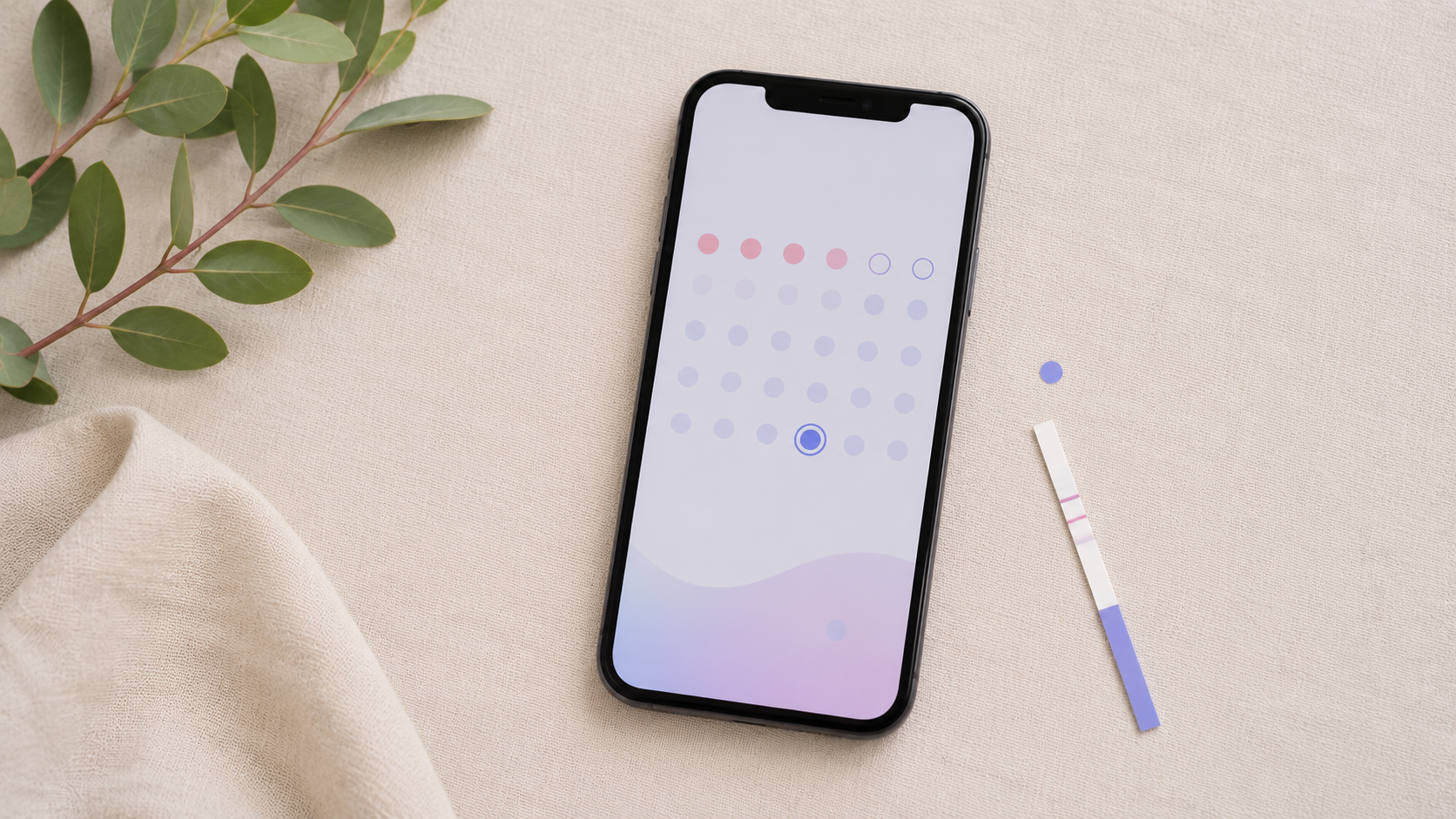
- Know your cycle day before you test. Many hormones are only meaningful on specific days. The Menstrual Cycle Calculator and Ovulation Calculator tell you where you are.
- Use LH kits to time conception. Start testing a few days before your estimated ovulation and pair with the Fertile Window Calculator.
- Treat AMH and FSH as conversation starters. Bring the result to a clinician with your cycle history rather than acting on it alone.
- Log results alongside symptoms and dates. A hormone number gains meaning next to your tracked cycle, not in isolation.
- See a clinician for irregular or absent cycles rather than self-diagnosing from a strip, especially if you suspect PCOS/PMOS or thyroid issues.
How Femora helps
An at-home hormone result is only interpretable with cycle context, and that context is exactly what Femora keeps.
- Cycle and ovulation tracking - so you know the right day to run a progesterone, FSH, or LH test
- Fertile window and ovulation predictions - to time LH kits and conception efforts
- Symptom and result logging - record hormone results next to flow, mood, and signs so patterns surface
- Exportable history - hand a clinician your cycle context alongside any test, which is what makes the number useful
Pair the app with the Ovulation Calculator, Fertile Window Calculator, and Conception Date Calculator, and see the companion piece on whether a wearable can predict your period.
The bigger picture
At-home hormone testing is a real step forward in access, and for one job, timing ovulation with an LH kit, it genuinely delivers. But the tests sold hardest as fertility and menopause answers, AMH and FSH, are the ones most likely to mislead when read alone. The fix isn't to avoid them. It's to know what each hormone reflects, test on the right day, and read the result next to your own cycle rather than as a standalone score.
Give your hormone results the cycle context that makes them meaningful with Femora. Free on iOS and Android.
Sources
- Testing and interpreting measures of ovarian reserve: a committee opinion - American Society for Reproductive Medicine (ASRM), 2020.
- Antimullerian hormone levels are associated with time to pregnancy in a cohort study of 3,150 women - Fertility and Sterility, 2024.
- Do I need to have testing of my hormone levels during perimenopause? - American College of Obstetricians and Gynecologists (ACOG).
- Home menopause testing kits - WebMD, 2024.
- Cervical mucus and ovulation predictor kits - Mayo Clinic, 2023.