Perimenopause in 2026: Why the Way It's Diagnosed Is Changing
New 2026 research shows perimenopause is widely misjudged: women expect hot flushes and weight gain, but most actually report fatigue, irritability, low mood, and poor sleep. Experts now want diagnosis to weigh symptom patterns alongside menstrual changes, not period changes alone.
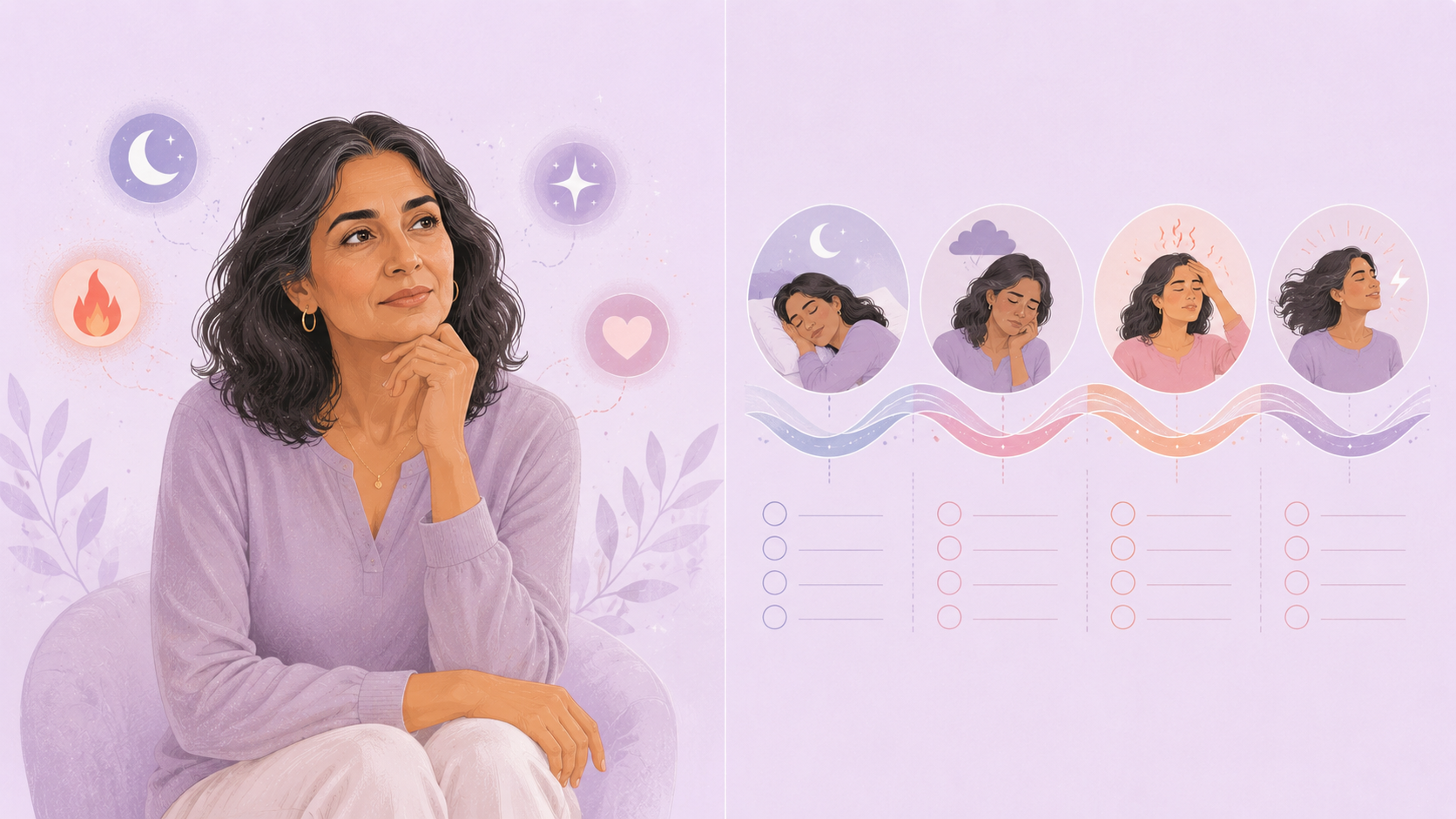
If you have been told you are "too young" for perimenopause because your periods are still regular, new research suggests that reasoning may be outdated. In January 2026, a large international study found a striking gap between the symptoms women associate with perimenopause and the symptoms they actually experience. Researchers and clinicians responded by calling for updated, symptom-based diagnostic criteria rather than relying on menstrual changes alone.
This matters because the current model can leave women undiagnosed for years. Almost 40 percent of perimenopausal women live with untreated hot flushes and night sweats, often because the changes were blamed on stress, ageing, or lifestyle instead of hormones. Here is what the new evidence shows, how perimenopause is diagnosed today, and what you can do to get care that matches your experience.
What perimenopause actually is
Perimenopause is the transition phase leading up to menopause, when your ovaries gradually wind down and hormone levels, especially estrogen, begin to fluctuate and decline. It is not a single event. It is a stretch of time that often lasts several years.
Most women enter perimenopause in their mid-40s, with around 47 as a typical age, though it can begin in the early 40s or even the late 30s for some. According to the NHS, perimenopause can last up to around 10 years before periods stop completely. You officially reach menopause only after 12 consecutive months without a period. Everything before that final period is perimenopause.
The defining feature is hormonal instability. Estrogen does not simply fall in a smooth line. It swings, sometimes higher than usual and sometimes much lower, which is why symptoms can feel unpredictable and why they often appear long before your cycle changes in any obvious way.
How perimenopause is diagnosed today, and why that misses so many women
The reference framework clinicians use is called STRAW+10, short for the Stages of Reproductive Aging Workshop, revised in 2012. It is widely treated as the gold standard for staging reproductive aging, and it leans heavily on menstrual cycle changes as the principal marker.
Under STRAW+10, early perimenopause is generally flagged when the length of your cycle starts to vary by seven or more days from your normal pattern. Later perimenopause is marked by longer gaps, including stretches of 60 days or more without a period. Hormone tests such as FSH and estradiol can support staging, but cycle changes do the heavy lifting.
There is a real problem hiding in that logic. Hormonal symptoms frequently begin before menstrual patterns visibly shift. A woman can have months of disrupted sleep, brain fog, anxiety, and joint aches while her periods still arrive more or less on schedule. Under a strictly cycle-first approach, she does not yet "qualify," so her symptoms get attributed to something else.
Two failure points show up again and again:
- Under-recognition in primary care. Hot flushes, sleep problems, and vaginal dryness are often normalised or filed under stress, ageing, or lifestyle rather than investigated as perimenopause.
- Self-dismissal. Women with regular cycles often assume they are too young or not "there yet," which delays them seeking help in the first place.
The result is a diagnostic gap that can run for years, precisely during the window when support would help most.
What the 2026 research found
The new evidence comes from a digital survey published in Menopause, the journal of The Menopause Society, reported in late January 2026. The study drew on data from the Flo health application and is titled, in summary form, a global survey of perimenopause knowledge and symptoms.
The scale is what gives it weight. The knowledge portion included 17,494 women across 158 countries, and the symptom analysis focused on 12,681 women aged 35 and over. That breadth lets researchers compare what women believe perimenopause looks like against what they report living through.
The mismatch was clear.
What women expected (most commonly recognised as perimenopause symptoms):
- Hot flushes: 71 percent
- Sleep problems: 68 percent
- Weight gain: 65 percent
What women actually reported (most common self-reported symptoms among those aged 35 and over):
- Fatigue: 83 percent
- Physical and mental exhaustion: 83 percent
- Irritability: 80 percent
- Depressive mood: 77 percent
- Sleep problems: 76 percent
- Digestive issues: 76 percent
- Anxiety: 75 percent
Notice that hot flushes, the single most "expected" symptom, does not top the list of what women experience. The everyday burden is dominated by fatigue, exhaustion, mood, and sleep, which are exactly the symptoms most likely to be brushed off as ordinary stress.
The study also found meaningful cultural and regional differences in both awareness and how women interpret their symptoms, which means a one-size-fits-all checklist serves some populations poorly. Dr. Stephanie Faubion, medical director of The Menopause Society, summarised the core finding as a discordance between knowledge of perimenopause and the symptoms actually experienced across global populations.
Taken together with earlier work showing vasomotor symptoms are markedly more common in perimenopause than before it, the picture supports a shift many experts now favour: a hybrid diagnostic model that adds strong symptom-based indicators to the existing menstrual criteria, rather than treating cycle changes as the only gateway to a diagnosis.
The under-recognised symptoms, grouped by category
Because perimenopause symptoms reach far beyond hot flushes, it helps to see them organised by system. If several of these cluster together in your 40s, or late 30s, perimenopause is worth raising with a clinician even if your periods are still regular.
Vasomotor (temperature regulation)
- Hot flushes, the sudden sensation of heat through the upper body, face, and neck
- Night sweats that soak bedding or wake you
- Flushing and a racing or pounding heartbeat during a flush
Sleep
- Difficulty falling asleep or staying asleep
- Waking in the early hours and not getting back down
- Unrefreshing sleep that leaves you exhausted regardless of hours in bed
Mood and mental health
- Irritability and a shorter fuse than usual
- Low mood or depressive feelings
- Anxiety, including new or worsening anxiety
- Mood swings and reduced self-esteem
Cognitive (brain fog)
- Trouble concentrating
- Word-finding difficulty and forgetfulness
- Slower mental processing. Research supports that these brain fog complaints are real, not imagined.
Musculoskeletal
- New or worsening joint aches and stiffness
- General body pain that does not have an obvious injury behind it
Genitourinary
- Vaginal dryness, which can persist after periods stop
- Discomfort during sex
- More frequent urinary urgency or urinary tract infections
Other common changes
- Persistent fatigue and physical or mental exhaustion
- Digestive changes, including bloating
- Weight changes, particularly around the middle
- Reduced libido
No one has every symptom, and they do not arrive in a fixed order. The signal is a pattern of several of these appearing together and persisting over months.
What to do: a doctor-ready plan
The single most useful thing you can bring to an appointment is data. A clear record turns a vague conversation into a focused one and helps a clinician see the pattern a single visit might miss.
- Track your cycles. Log every period start and end date for at least three to six months. Cycle length that begins varying by seven or more days is a recognised early marker, so the trend matters as much as any single month.
- Track your symptoms daily. Note severity for sleep, mood, energy, hot flushes, brain fog, joint aches, and any genitourinary changes. Daily logging captures the fluctuation that defines perimenopause better than memory does.
- Note the impact. Record how symptoms affect work, relationships, and daily function. The NHS is explicit that getting advice early reduces the toll perimenopause takes on health, relationships, and work.
- Bring the summary to your appointment. Lead with your symptom pattern and your age, not only your periods, so the conversation is not closed off by "your cycle is still regular."
- Ask specific questions. Could these symptoms be perimenopause given my age and pattern? Is hormone replacement therapy appropriate for me? What are the options for my most disruptive symptoms, whether that is sleep, mood, or vasomotor symptoms? Be aware that for most women over 45 with typical symptoms, blood tests are not required to diagnose perimenopause, so do not let the absence of a test dismiss your experience.
- Ask about treatment routes. HRT is the main medical treatment for perimenopause and menopause symptoms. For low mood or anxiety, options can include talking therapies such as CBT. Vaginal dryness and libido have their own targeted treatments. Knowing the menu helps you advocate for yourself.
A tool like a structured perimenopause quiz or a menopause symptom score can help you put numbers to what you are feeling before you walk in.
When to seek help and red flags
Some symptoms are not just part of the transition and should prompt prompt medical review. See a clinician without delay if you notice:
- Bleeding between periods or after sex
- Very heavy bleeding, such as soaking through protection every hour or passing large clots
- Bleeding that returns after you have gone 12 months without a period, which is postmenopausal bleeding and always needs assessment
- Periods that suddenly become much closer together or far heavier than your normal pattern
These can have benign explanations, but they need to be checked rather than assumed to be hormonal.
It is also worth flagging timing. If perimenopausal symptoms begin before age 40, that raises the question of early menopause or premature ovarian insufficiency, which deserves specific evaluation rather than reassurance that you are too young. Age should never be the only reason your symptoms are dismissed, in either direction.
How Femora helps
Femora is built around exactly the kind of pattern tracking the 2026 research argues for. Instead of waiting for your cycle to change in an obvious way, you can capture the symptoms that actually dominate perimenopause from the start.
- A dedicated perimenopause flow that recognises this is a distinct life stage, not just a longer version of regular cycle tracking.
- Daily symptom tracking across the categories that matter most, including sleep, mood, energy, hot flushes, brain fog, joint aches, and genitourinary changes, so the fluctuation shows up clearly over time.
- A guided perimenopause quiz and a menopause symptom score that translate how you feel into something structured you can share with a clinician.
- A focused menopause mode that adapts the app to this stage rather than assuming a predictable monthly cycle.
When you can hand a clinician months of organised data instead of a fuzzy memory, you make a symptom-based conversation far easier to have. For a fuller walkthrough of the stages and your options, see our 2026 guide to perimenopause and menopause.
The bigger picture
The 2026 findings are part of a wider correction in women's health. For years, perimenopause was framed narrowly around hot flushes and irregular periods, which meant the most common lived experiences, fatigue, mood changes, poor sleep, and brain fog, were under-counted and under-treated. A model that waits for menstrual changes inevitably lags behind the hormones driving the symptoms.
A hybrid approach that takes symptom patterns seriously alongside cycle data would catch more women earlier, reduce years of misattributed suffering, and reflect how varied this transition really is across different bodies and different parts of the world. Until that change is formalised in clinical guidance, the practical defence is the same one the research points to: know the full range of symptoms, track them, and bring that evidence to your care.
Your experience is data. The more clearly you can show it, the harder it is to dismiss.
Take charge of your perimenopause journey. Download Femora to track your symptoms and cycles, and walk into your next appointment prepared.
Sources
- International Differences Exist in Knowledge Gaps and Most Common Perimenopause Symptoms - The Menopause Society, January 2026.
- Perimenopause in 2026: why new global research calls for updated diagnostic criteria and improved symptom recognition - SFI Health, 2026.
- Executive summary of the Stages of Reproductive Aging Workshop + 10: addressing the unfinished agenda of staging reproductive aging - PMC, US National Library of Medicine, 2012.
- Perimenopause - Symptoms and causes - Mayo Clinic.
- Menopause and perimenopause - NHS.