Starting HRT: What to Expect With Estrogen-Only, Progesterone, and Combination Therapy
Which HRT you start depends on your uterus: estrogen-only HRT if you have had a hysterectomy, combination HRT (estrogen plus progesterone) if you have a uterus, because estrogen alone overstimulates the womb lining. Expect hot flashes to improve within a few weeks, full benefits by 3 months, and mild early side effects - breast tenderness, nausea, and irregular bleeding - that usually settle within 3 months. Your first review is at around 3 months, and finding the right dose or delivery method can take a couple of adjustments.
Deciding to start hormone replacement therapy is usually the hard part. But the first weeks on HRT come with their own questions: Which type am I actually taking, and why? Are these side effects normal? When will it start working?
Here is a practical map of what to expect - the differences between estrogen-only, progesterone, and combination HRT, the realistic timeline for benefits, and the early bumps that usually smooth out.
First: why there are different types of HRT
HRT is not one medication. It is built from two hormones, and which ones you need depends on one question: do you have a uterus?
- Estrogen is the active ingredient - the hormone that actually relieves hot flashes, night sweats, mood symptoms, and vaginal dryness.
- Progesterone (or a synthetic progestogen) has one main job in HRT: protecting the womb lining. Estrogen on its own stimulates the lining to thicken, which over time raises the risk of endometrial cancer. Progesterone keeps that in check.
That single fact explains the whole menu.
Estrogen-only HRT
If you have had a hysterectomy, there is no womb lining to protect - so you take estrogen alone. This is the simplest form of HRT, and large studies show it has the most favorable risk profile, including no meaningful increase in breast cancer risk in the major trials.
Estrogen comes as:
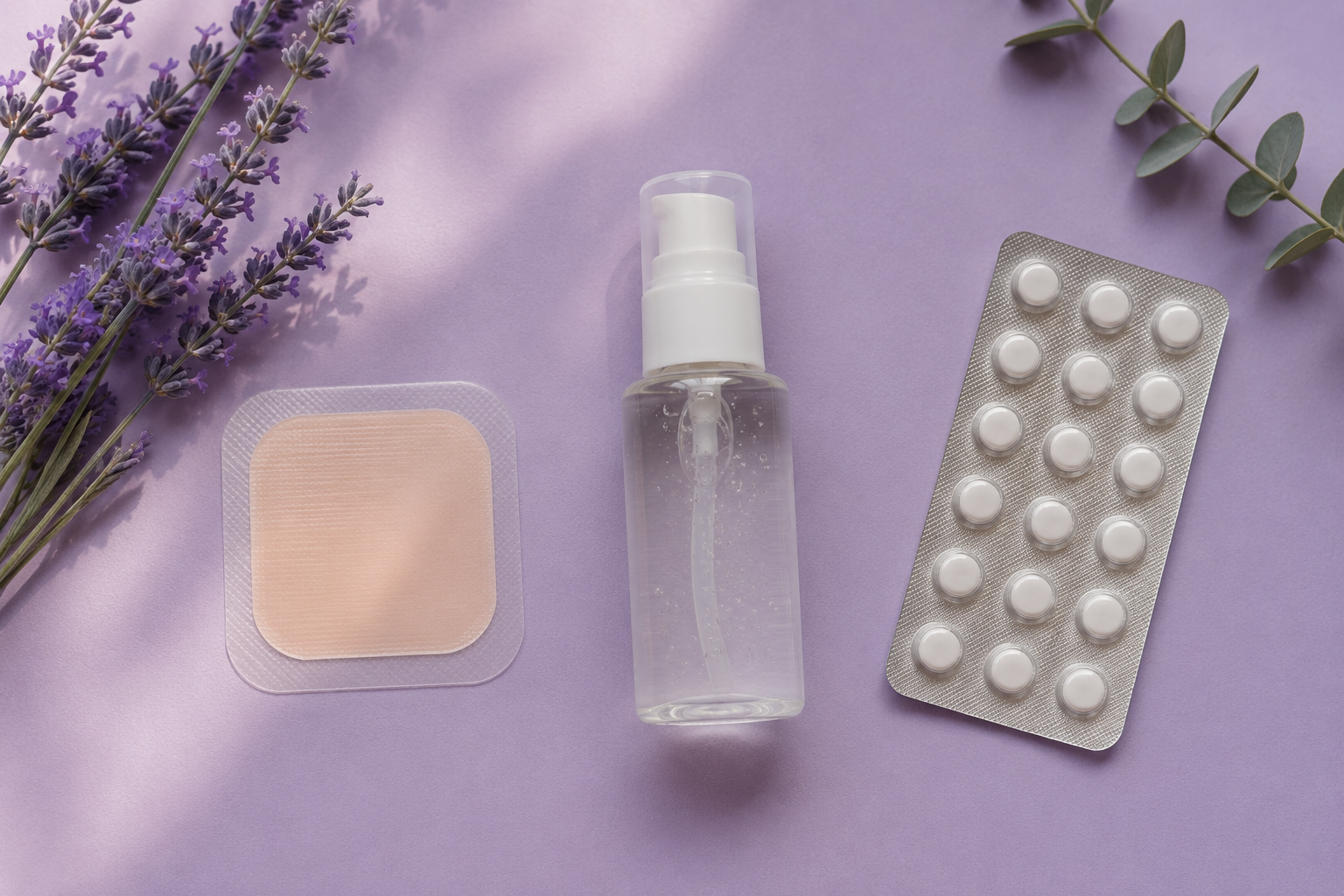
- Patches - stuck on the skin below the waist, changed once or twice a week. Steady hormone levels, and transdermal delivery does not raise blood clot risk the way tablets can.
- Gel or spray - rubbed or sprayed on daily; easy to fine-tune the dose.
- Tablets - convenient, but oral estrogen carries a small blood clot risk that skin delivery avoids.
Most women starting today are offered transdermal (skin) estrogen first, especially if they have any clot risk factors, migraine, or high blood pressure.
Combination HRT: estrogen plus progesterone
If you have a uterus, you take both hormones. The estrogen does the symptom relief; the progesterone protects the lining. Combination HRT comes in two rhythms, and which one you start depends on where you are in the transition:
- Sequential (cyclical) HRT - estrogen every day, progesterone for 10-14 days of each cycle, followed by a monthly withdrawal bleed. This is the usual starting point if you are still having periods or within 12 months of your last one (perimenopause).
- Continuous combined HRT - both hormones every day, no scheduled bleed. This is for women at least 12 months past their final period. Starting it too early in the transition tends to cause erratic bleeding, which is why the sequential form exists.
Your clinician may switch you from sequential to continuous once you are clearly postmenopausal - a normal upgrade, not a sign anything is wrong.
The progesterone component
"Progesterone HRT" is not usually taken alone - its role is partnership with estrogen. But the type of progestogen matters more than most women are told:
- Micronized progesterone (body-identical, e.g. Utrogestan/Prometrium) is chemically identical to what your ovaries made. Evidence suggests it carries a lower breast cancer and clot risk than older synthetic progestogens, and its mild sedative effect - it is taken at bedtime - can actually help sleep.
- Synthetic progestogens in some combined tablets and patches are effective but slightly less favorable in the risk data.
- A hormonal IUD (like Mirena) can serve as the progesterone arm of HRT while also providing contraception - a neat two-in-one for perimenopausal women who still need it.
Progesterone alone is occasionally used for specific situations (like heavy perimenopausal bleeding or when estrogen is not tolerated), but it is not a substitute for estrogen's symptom relief.
The timeline: when things actually improve
Expectations matter, because HRT is not instant:
- Weeks 1-4: hot flashes and night sweats usually begin easing within a few weeks. Sleep often improves early, partly because sweats stop breaking it.
- By 3 months: the full effect on flashes, sweats, and mood should be apparent. Most guidelines - including NICE - set the first review at 3 months for exactly this reason.
- 3-6 months or longer: vaginal dryness responds more slowly to systemic HRT; if it is a main symptom, ask about adding local vaginal estrogen, which targets it directly and is safe alongside systemic HRT.
- Body and skin changes (joint aches, skin quality) improve gradually over months, not weeks.
If nothing has improved by three months, that is not a failure - it usually means the dose or delivery method needs adjusting. It is common to try a couple of combinations before finding your fit.
Early side effects - and which ones settle
Starting HRT introduces hormones your body has been running low on, and the adjustment is noticeable for many women:
- Breast tenderness or swelling - very common in the first weeks, usually settles by 3 months.
- Nausea or mild headaches - more common with tablets; taking them with food or at night helps, and switching to a patch or gel often resolves it.
- Bloating - typically eases as your body adjusts.
- Irregular bleeding or spotting - common in the first 3-6 months, especially on continuous combined HRT or with a new hormonal IUD. Expected early; worth reporting if it persists beyond 6 months or starts after a stretch of no bleeding.
- Mood wobbles on the progesterone days - some women on sequential HRT notice PMS-like symptoms during the progesterone phase; switching progestogen type or delivery can fix this.
The pattern to remember: most side effects fade by 3 months. Persisting side effects are a reason to adjust, not to give up on treatment altogether.
When to call your clinician sooner
- Signs of a clot: a painful swollen calf, sudden breathlessness, or chest pain - rare, but urgent.
- Migraine with aura appearing for the first time.
- Heavy or persistent bleeding beyond the expected settling-in pattern, or any bleeding that starts after months of none.
- Side effects that are clearly getting worse rather than better.
How Femora helps
The 3-month review works best when you arrive with data, not impressions. Femora's menopause mode lets you log hot flashes, night sweats, sleep, mood, and bleeding from the day you start HRT, and the menopause symptom score gives you a before-and-after number that shows exactly how much the treatment is doing - and whether an adjustment helped. If you are still weighing the decision itself, our full guide to menopausal hormone therapy covers the benefit-risk picture, and the non-hormonal options guide covers the alternatives.
The bigger picture
Starting HRT is a beginning, not a verdict. The first three months are an adjustment period - for your body and for the prescription itself - and the version of HRT you end up on may differ from the one you started. What matters is the direction: symptoms easing, side effects settling, and a treatment tuned to your body rather than a one-size default.
This is general information, not a substitute for advice from your own clinician. Download Femora to track your symptoms from day one of HRT.
Sources
- Types of hormone replacement therapy (HRT) - NHS.
- Side effects of hormone replacement therapy (HRT) - NHS.
- Menopause: diagnosis and management (NG23) - National Institute for Health and Care Excellence (NICE).
- The 2022 Hormone Therapy Position Statement of The North American Menopause Society - The Menopause Society, 2022.
- Hormone therapy: Is it right for you? - Mayo Clinic.