The Four Phases of Your Cycle (and What Each Feels Like)
The menstrual cycle has four phases, each driven by different hormones. The menstrual phase (your period, roughly days 1-5) is when the lining sheds and energy is lowest. The follicular phase (after the period, up to ovulation) is when estrogen rises and energy, mood, and focus improve. Ovulation (around day 14 in a 28-day cycle) is the fertile window, marked by an LH surge, egg-white cervical mucus, and peak energy and libido. The luteal phase (after ovulation, before the next period) is when progesterone rises and premenstrual symptoms appear as hormones fall. Cycle lengths vary (21-35 days is normal), so track yours for a few months to learn your real phase lengths and plan around your energy.
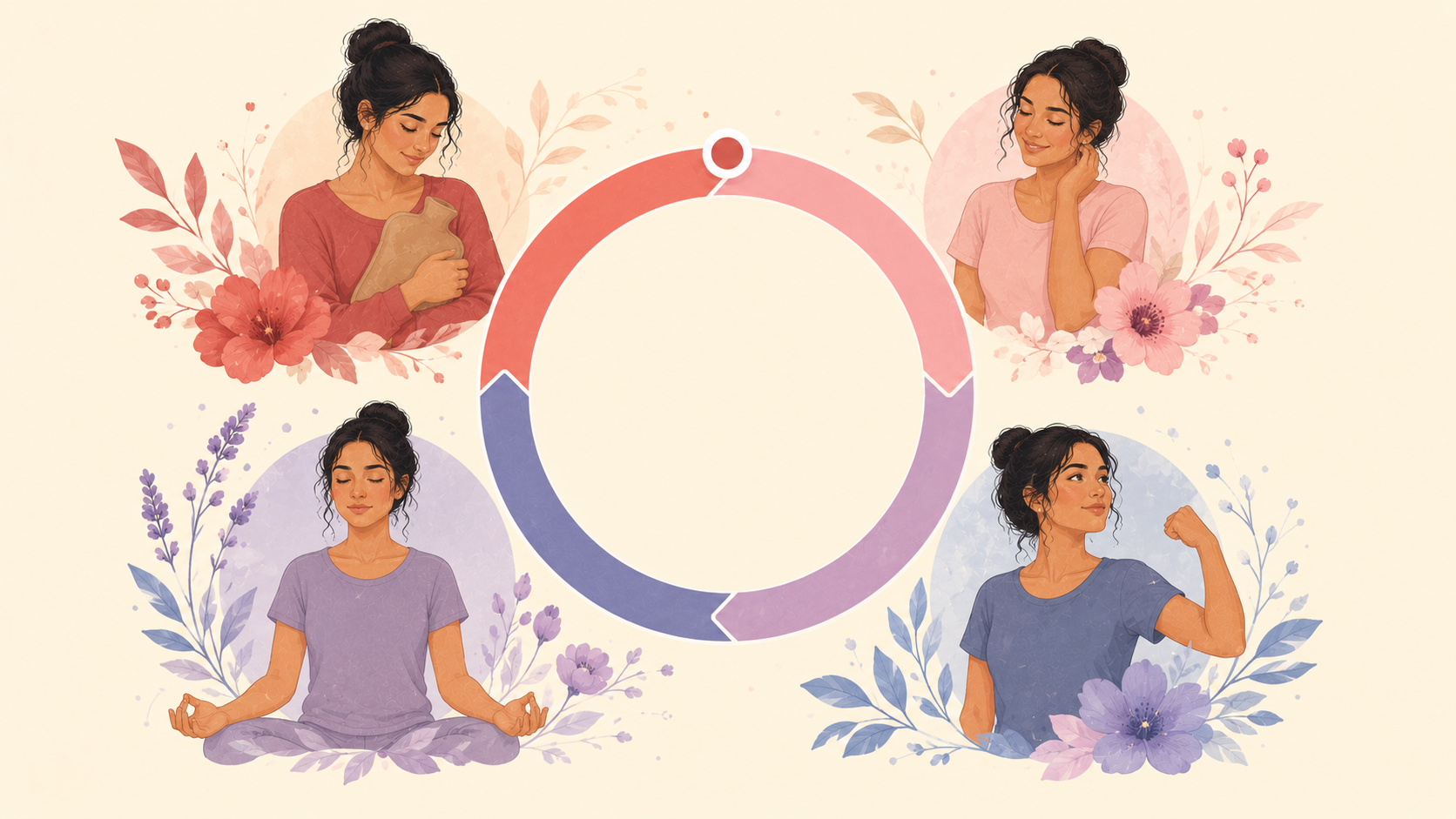
Your menstrual cycle is not just the few days you bleed. It is a roughly month-long sequence with four distinct phases, each driven by a different mix of hormones, and each with its own characteristic energy, mood, and physical signs.
Once you understand the four phases, a lot of things that felt random start to make sense: why your energy surges some weeks and crashes others, why your skin or sleep changes, why your mood is not the same on day 6 as on day 24. None of it is in your head - it is your hormones moving through a predictable arc.
Here is what happens in each phase, what it tends to feel like, and how to work with your cycle instead of against it.
The quick map
A typical cycle is about 28 days, though anywhere from 21 to 35 is normal. It runs in four phases:
- Menstrual - your period (roughly days 1-5)
- Follicular - after your period, before ovulation (roughly days 1-13, overlapping the period)
- Ovulation - the release of an egg (around day 14 in a 28-day cycle)
- Luteal - after ovulation, before your next period (roughly days 15-28)
The exact days shift with your own cycle length - mostly the follicular phase stretches or shortens, while the luteal phase stays closer to a steady 12 to 14 days.
Phase 1: Menstrual (your period)
What happens: If no pregnancy occurred, estrogen and progesterone drop, and the uterine lining sheds as your period. This is day 1 of your cycle.
What it tends to feel like:
- Lower energy, especially on the heaviest days
- Cramps, lower-back ache, fatigue
- A need for rest and quiet for many women
Working with it: Be gentle. Prioritize sleep, iron-rich food, and lighter movement like walking or stretching. If bleeding is very heavy or pain is severe, that is worth investigating - see heavy periods and iron deficiency.
Phase 2: Follicular
What happens: The brain signals the ovaries to ripen follicles, and estrogen rises. The uterine lining starts rebuilding. This phase overlaps the period at the start and runs up to ovulation.
What it tends to feel like:
- Rising energy and a brighter mood as estrogen climbs
- Better focus and motivation
- Often the best skin and sleep of the cycle
Working with it: This is your natural high-energy window. Many women find it the best time for harder workouts, demanding projects, and new starts.
Phase 3: Ovulation
What happens: A surge in luteinizing hormone (LH) triggers the ovary to release an egg. Estrogen peaks just before. This is your fertile window - the egg survives about 24 hours, but sperm can survive several days, so the few days around ovulation are when conception is most likely.
What it tends to feel like:
- Peak energy, confidence, and libido for many women
- Egg-white, stretchy cervical mucus
- A mild one-sided twinge (mittelschmerz) for some
- A small rise in basal body temperature just after
Working with it: If you are trying to conceive, this is the window - see ovulation symptoms and time intercourse to the days leading up to it. If you are avoiding pregnancy, this is the time to be most careful.
Phase 4: Luteal
What happens: The emptied follicle becomes the corpus luteum and releases progesterone, which thickens the uterine lining in case of pregnancy. If there is no pregnancy, progesterone and estrogen fall at the end of the phase, leading to your next period.
What it tends to feel like:
- Energy gradually winding down
- The classic premenstrual symptoms in the days before your period: bloating, breast tenderness, mood changes, cravings, irritability
- For some, more significant mood symptoms - if they are severe, see PMS vs PMDD
Working with it: Ease off the intensity. Steady routines, good sleep, and managing stress help most. Gentler movement and balanced meals can soften premenstrual symptoms.
Why the phases are worth knowing
When you can see which phase you are in, you can:
- Plan around your energy instead of fighting it - schedule demanding work for the follicular and ovulatory weeks, and protect rest in the late luteal and menstrual phases.
- Read your symptoms rather than be blindsided by them - knowing the luteal dip is coming makes it easier to manage.
- Spot what is not normal - a phase that is wildly off, very heavy bleeding, or severe symptoms become easier to flag when you know your baseline.
This idea is sometimes taken further as "cycle syncing." For what the evidence actually supports, see our cycle syncing 2026 evidence review.
What to do
- Track your cycle for two to three months to learn your real phase lengths - they are personal.
- Note energy, mood, and symptoms alongside the dates so you can see your own pattern across the four phases.
- Plan with the pattern where you can, rather than expecting the same of yourself every week.
- Use the fertile window intentionally - to conceive or to avoid pregnancy.
- Flag anything that breaks your pattern with your clinician.
How Femora helps
The four phases are abstract until you can see exactly where you are in them - which is what a cycle tracker makes concrete.
With Femora you can:
- See your current phase at a glance on the cycle ring, with the day count and what to expect.
- Predict ovulation and your fertile window with the ovulation calculator and menstrual cycle calculator.
- Log how each phase feels - energy, mood, symptoms - so the pattern becomes yours, not a textbook average.
The bigger picture
A period is the headline, but the cycle is the whole story - four phases, each with its own hormonal weather. Learning them turns your cycle from a monthly surprise into something you can anticipate and plan around. You do not have to overhaul your life to benefit. Simply knowing which phase you are in is often enough to make the month feel less random and more yours.
See exactly which phase you are in, every day, with Femora. Free on iOS and Android. Track your energy and symptoms across all four phases of your cycle.
Sources
- Menstrual Cycle (Normal Menstruation) - Cleveland Clinic, 2024.
- Your menstrual cycle - Office on Women's Health, U.S. Department of Health & Human Services, 2024.
- Menstrual cycle: What's normal, what's not - Mayo Clinic, 2023.
- Periods and fertility in the menstrual cycle - NHS, 2024.